6. Intent and specification engineering
How business intent becomes a governed, versioned, testable specification before any agent is given implementation authority — the five things to extract from intent, the Plan as an executable contract, the task graph, approval semantics — from the Business Understanding layer through Mission, Plan, and WorkOrder to the prototype-as-spec workflow.
On this page7 sections
The previous chapter described the records that carry work through the factory. This chapter is about the first and most dangerous translation among them: turning what a person wants into something an agent can be held to. Most agent failures that look like coding failures are actually specification failures that happened before any code existed. After reading this chapter you should be able to take an ambiguous request, turn it into a governed Mission with testable criteria, have a plan reviewed against it, and know exactly which downstream records a change to the specification invalidates.
The problem
"Improve onboarding" is a legitimate business objective. It is also unimplementable. It does not say which users, what behaviour should change, what constraints apply, which outcomes would be unacceptable, or what proof would demonstrate success. When an agent starts from that sentence, the product and risk decisions hidden inside it do not disappear; they are made silently by the executor, one token at a time.
Fluent agents make this failure hard to see. A human engineer handed "improve onboarding" would come back with questions. An agent will produce a confident plan, plausible code, and green tests for whatever interpretation it landed on. The first hallucination in an agentic system usually happens before code: the system invents what "done" means.
The translation fails for predictable reasons. Business language optimises for direction; engineering specifications optimise for decision and verification. Hidden assumptions stay hidden. Quality attributes are omitted because nobody says "and it should still be fast". Examples get mistaken for complete requirements. Acceptance criteria describe activity ("add a retry") rather than observable outcomes ("no duplicate PR is ever created").
Requirements also interact. A latency target can conflict with an audit-retention rule. A data-deletion requirement can conflict with immutable evidence. A plan can cover every functional criterion and still ignore migration, rollback, authorisation, or observability. Completeness is a property of the whole set in its operating context, not of individually polished sentences.
The factory therefore needs an upstream assurance boundary: business intent must become a governed, versioned, testable specification before implementation authority is granted.
How it works
Business Understanding is the first layer
In the twelve-layer view of a production agent system (Chapter 25), the bottom layer is not data, models, or infrastructure. It is Business Understanding: define the decision, the constraints, the ownership, and the success criteria. Every layer above it selects, retrieves, reasons, loops, and evaluates in service of a decision that was defined here. If this layer is vague, no amount of engineering above it can compensate, because the system will be optimising a target nobody chose.
Think of an architect's brief. A client who says "I want a nicer house" gets whatever the builder feels like building. A client who says "four bedrooms, north-facing living room, under this budget, on this lot, compliant with this code, ready by this date, and here is how we will inspect it" gets a house they can accept or reject on stated grounds. The brief is not the drawings and it is not the building; it is the thing both are judged against.
The Intent layer: inputs and outputs
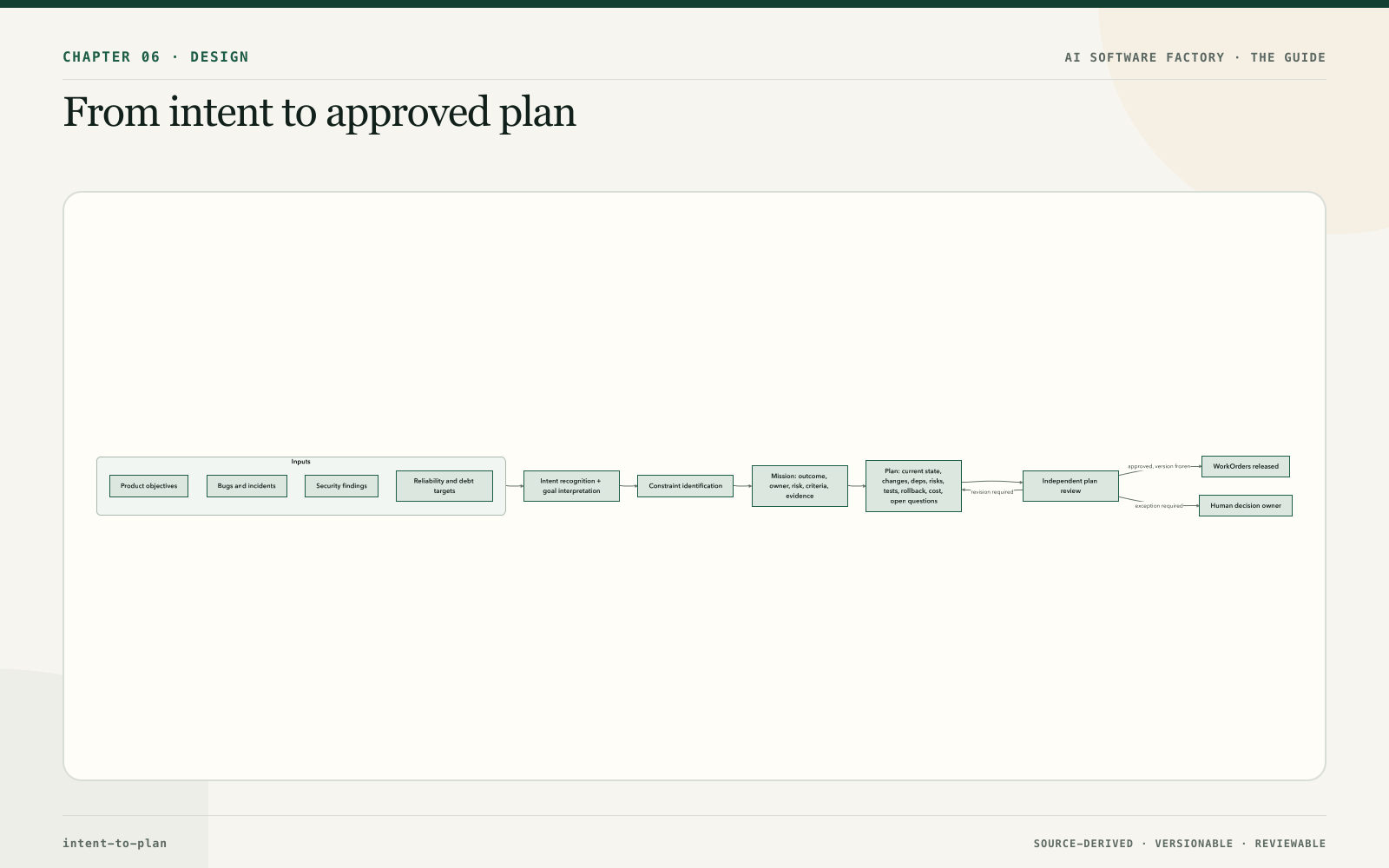
Intent arrives from many directions, and a factory should be able to take all of them. Product objectives. Customer problems. Bugs. Feature requests. Operational incidents. Security findings. Reliability targets. Technical-debt priorities. None of these is a specification; each is raw material.
The Intent layer turns that raw material into structured engineering work. Its outputs are the records Chapter 5 defined: Missions, WorkOrders, acceptance criteria, constraints, risk classification, required evidence, and ownership. The capabilities involved have names worth knowing because they are what you are actually building or buying:
- Intent recognition — understanding the requester's actual goal, which is often not the literal request.
- Goal interpretation — translating the request into a concrete outcome.
- Constraint identification — recognising the technical, security, policy, and resource boundaries that apply.
- Acceptance criteria — defining what "done" means in observable terms.
- Task decomposition — breaking complex work into smaller executable units.
- Planning — determining the steps and their sequence.
- Task definition — creating clear units of work for agents.
- Dependency mapping — identifying ordering and dependencies between those units.
- Agent routing — selecting the appropriate agent or capability for each unit.
- Dynamic replanning — adjusting the plan when execution produces unexpected results, without silently changing the goal.
The builder experience
The Intent layer has a customer, and the customer is not the platform team. It is the builder: the person, or the agent acting for a person, who arrives with an outcome they must accomplish and leaves with governed work in flight. Everything the factory does to make that arrival and departure easy is the Builder Experience (BX), and it deserves the same design attention as the records underneath it, because a factory nobody can enter is a factory nobody uses.
Design it customer-backward. Start from what the builder must accomplish, in the builder's own terms, and work backward into the platform capability that accomplishes it. The opposite habit, starting from the harness, the model gateway, or the skill registry and asking builders to learn them, produces a platform that is complete and unused. The test is blunt: the builder should never need to understand the model, the harness, the skill, or the MCP implementation. Those are the factory's concerns. The builder's concerns are the five extractions below, the risk they carry, and the decisions they will be asked to make.
Because builders differ, the factory names builder personas and designs for each. A developer arrives with repository scope and tests and wants the shortest path to an evidence-bearing pull request. A product manager arrives with an outcome statement and needs the factory to supply repository boundaries, deployment risk, and testing expectations without asking. A quality engineer arrives with acceptance scenarios that are already half a specification. A designer arrives with a prototype. Another agent arrives through an API with a structured request and no authority of its own. Stage 1 tabulates what each brings and lacks; the point here is that a persona is a design input, not a marketing label, and that every persona converges on the same Mission, Plan, and WorkOrder records.
The builder journey is the path a persona travels from first contact to routine use: discovery, first intent, first accepted outcome, first trusted production change, repeat use, and, for the builders who stay, end-to-end ownership of a workflow they now run through the factory rather than around it. Each stage of the journey has a measurable exit (time to first successful workflow, time to first accepted PR, repeat-use rate) and a characteristic way of failing (the governed path was slower than pasting a prompt into a chat window). Think of a new hire's first month: the organisation that plans the first day, the first commit, and the first on-call shift keeps people; the one that hands over a laptop and a wiki does not.
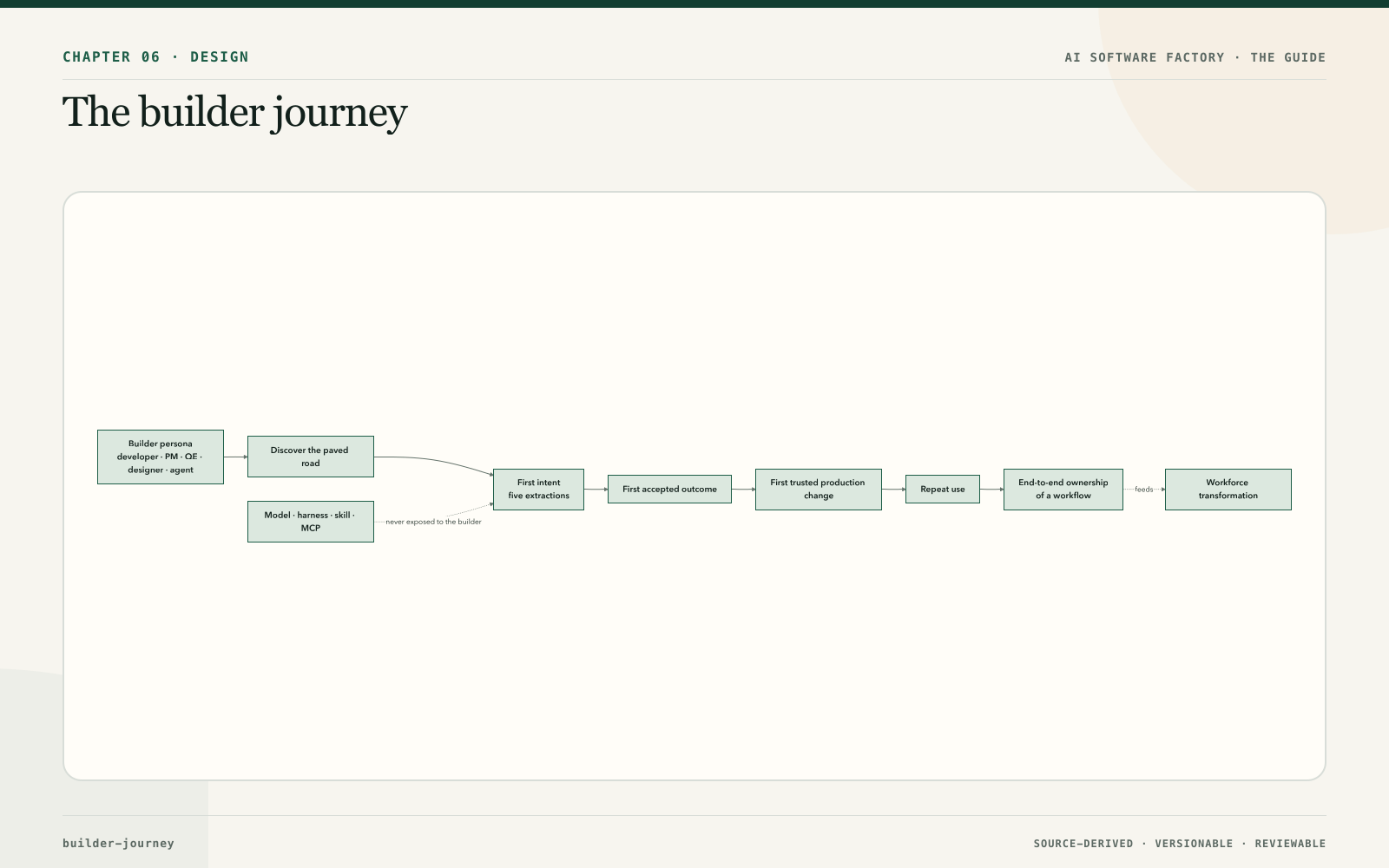
The journey is also where adoption becomes workforce transformation. Adoption is a count of builders using the factory. Transformation is a change in what engineering work is: developers who spend their week reviewing plans, weighing decisions, and approving consequential changes while agents implement and validate, and product, quality, and design roles that can express intent directly rather than through a ticket to a developer. A factory that is adopted without transforming the work has automated the old job; a factory designed customer-backward changes the job, which is the outcome the economics in Chapter 8 actually measure.
Five things to extract from intent
Intent understanding and planning are different jobs, and the first design decision is to keep them apart. The builder states the outcome they want; the factory's first move is not to plan but to translate that statement into five explicit things, each of which is a question the builder can confirm or correct:
| Extract | The question it answers | Why the factory needs it before planning |
|---|---|---|
| Objective | What should be different when this is done? | Without it, the agent optimises the literal request |
| Constraints | What must not change? | Without it, the cheapest route is through something that mattered |
| Context | Which repositories, systems, standards, and prior decisions apply? | Without it, the agent rediscovers or contradicts decisions already made |
| Acceptance criteria | How will we objectively know it worked? | Without it, "done" is invented downstream |
| Risk | What is the blast radius if this is wrong? | Without it, every change gets the same review |
The translation must surface material ambiguity rather than resolve it silently. "Improve checkout performance" is a good example because it sounds specific. Which path: the cart, the payment call, the confirmation page? Which percentile: median, p95, p99? What target: a number, or "faster than last quarter"? What regression tolerance: may error rate rise by a basis point to gain latency? Each answer changes the implementation and the risk. The rule for when to interrupt the builder is proportionate: ask when the ambiguity materially affects implementation or risk, and otherwise record the assumption with provenance and proceed. The failure the rule prevents is the most expensive one a factory can produce, an agent efficiently solving the wrong problem, because every downstream stage then does its job well on the wrong thing. Intent says what outcome; the Plan says how. Keeping those two records apart is what lets a change of mind about the outcome invalidate the plan instead of quietly surviving inside it.
Work shaping and the Definition of Correct
The five extractions are the content of a discipline that deserves its own name, because it is the job the intent layer exists to do. Work shaping is the transformation of ambiguous demand into bounded, agent-legible work with explicit goals, constraints, scope, risk, and verification criteria. Everything upstream of shaping is demand: a customer complaint, a metric that moved, a sentence in a ticket. Everything downstream is execution. Shaping is the seam, and it is where human effort concentrates once implementation is cheap: humans move from writing implementation to shaping executable intent. Chapter 4 places the shaping role in the operating model; this chapter gives it a specification to fill.
Shaping one piece of work well is not enough, because the same standards recur across every piece of work in a repository or a domain, and restating them per ticket is how they drift. The durable form is the Definition of Correct: a machine-consumable description of acceptable work for a task, component, repository, or domain, made of requirements, standards, policies, architecture, constraints, acceptance criteria, and verification rules. It is what good looks like, written down well enough that an agent and a verifier can both reason about it. A shaped piece of work inherits its domain's Definition of Correct and adds only what is specific to itself; the five extractions are the specific part, and the Definition of Correct is the standing part. The principle underneath is the one Chapter 19 builds the context-centric factory on: you cannot reliably automate what you have not adequately defined. A factory that automates against an undefined standard has automated the argument about what the standard was.
From intent to a governed Mission
A Mission is an owned outcome, not a prompt. Converting intent into one means establishing, in writing:
- the business outcome and the affected users;
- scope, exclusions, ownership, priority, and time constraints;
- functional requirements and measurable non-functional requirements;
- architecture, data, security, regulatory, and operational constraints;
- expected failure modes and the recovery behaviour required;
- the risk class and the decision owners it requires; and
- the evidence that will show the outcome was achieved.
Three records share this territory and it is important not to let them merge. The Mission is the authority for why the work exists. The Plan explains how the factory proposes to achieve it. The WorkOrder authorises a bounded part of that plan. Collapse them and implementation detail starts rewriting business intent, because the record that says "how" has become the record that says "why".
Requirements, criteria, assertions, and evidence
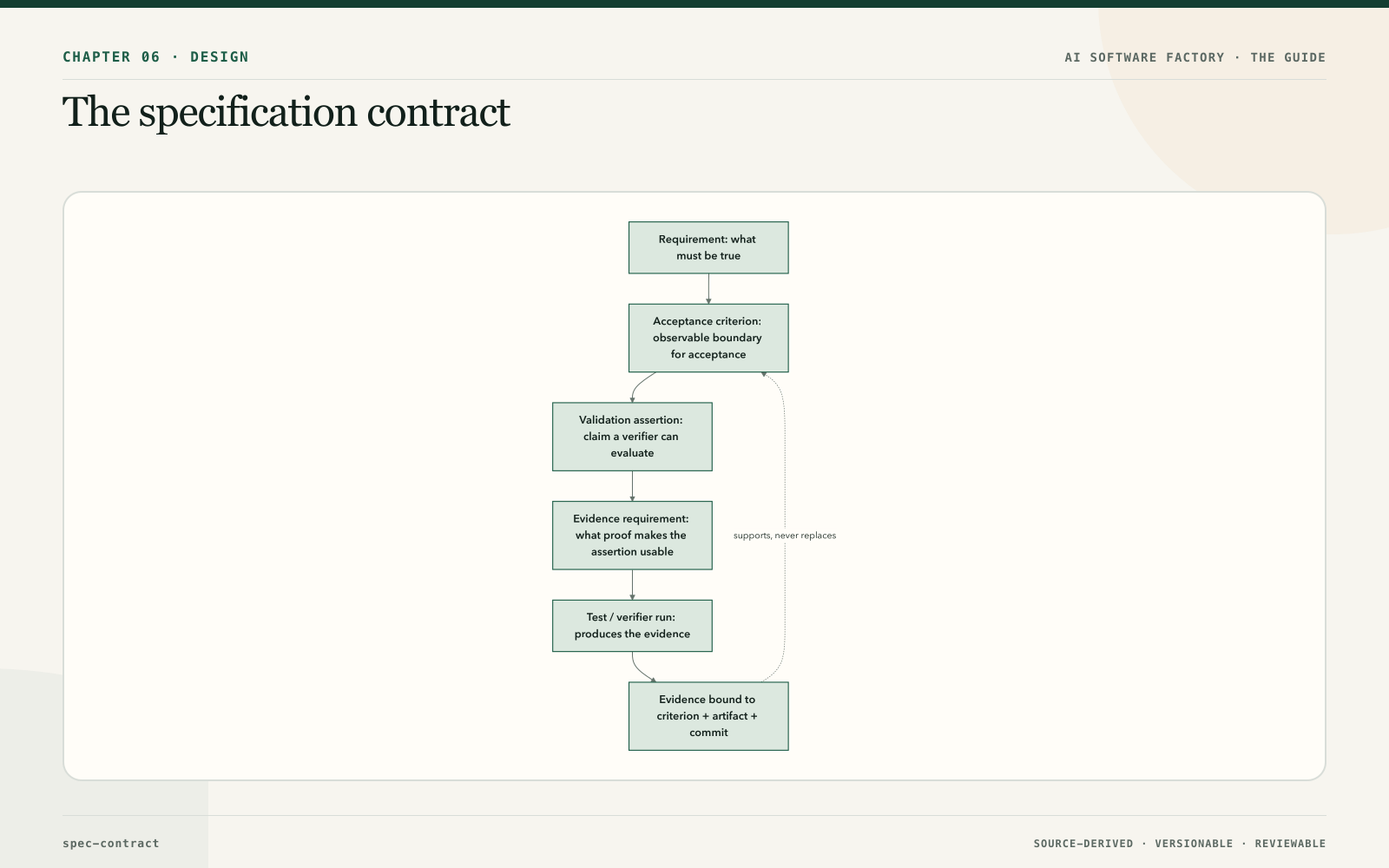
The heart of specification engineering is a four-way distinction that most teams blur into "the acceptance criteria". Each answers a different question, and a specification that is missing any one of the four cannot be enforced.
| Construct | Purpose | Example |
|---|---|---|
| Requirement | What must be true | "A user cannot read another tenant's records." |
| Acceptance criterion | What observable boundary determines acceptance | "Every cross-tenant read returns the policy-defined denial without disclosing record existence." |
| Validation assertion | A specific claim a verifier can evaluate | "Given Tenant A credentials and Tenant B record ID, GET /records/:id returns 404 and emits a denied-access audit event." |
| Evidence requirement | What proof makes the assertion usable | Independent integration run, exact build digest, audit-event receipt, tool identity, and freshness window |
Acceptance criteria should be outcome-oriented and implementation-neutral wherever possible; they describe the boundary, not the mechanism. Assertions may be implementation-aware, because they define a method of proof. Tests are evidence-producing mechanisms; they are not the requirement. A test that passes proves the assertion held for that artifact in that environment at that time, nothing more. This is why Chapter 5 insisted that evidence, not status, is what advances work.
Taken together, the assertions and evidence requirements for one piece of work form its verification contract: the structured list of claims that must be demonstrated before completion and how each will be validated. A complete specification has two halves, and a specification with only the first is a wish. The first half says what is wanted; the second half says, claim by claim, what will count as proof: the login works, and the evidence is a browser test that authenticates; there is no accessibility regression, and the evidence is the accessibility verifier passing; latency stays under the threshold, and the evidence is the benchmark. Writing the contract at specification time, rather than discovering it at review time, is what makes the outcome delegable, because the agent can be told to produce X subject to Y and prove A through F before it declares completion, and the verifier can be handed the same list. Chapter 27 defines the contract's fields and what happens to it downstream; the point for the specification is that it is part of the specification, not an afterthought of quality engineering.
Quality attributes and invariants
Functional behaviour is only part of the contract. A non-functional requirement is testable only when it names a measure, an operating condition, a population, a threshold, and an observation window. "p95 latency below 300 ms under the defined load profile over a 24-hour window" can be verified. "Fast" cannot, and an agent asked to make something fast will make it fast by its own definition.
An invariant is a condition that must hold across all permitted states and transitions. Tenant isolation. Append-only acceptance history. No deployment without an eligible artifact digest. No completion report from a stale lease. Invariants differ from architecture constraints: constraints say how the solution space is bounded; invariants say what must never become false. Invariants belong at the Mission or Plan level, because a single WorkOrder can be locally complete while violating one.
Design failure and recovery before the happy path
For each material dependency and each state transition, the specification should say what happens when it fails: timeout, retryability, idempotency, cancellation, partial success, reconciliation, rollback, and the operator-visible state. "GitHub is unavailable" is a failure mode. "The Attempt retains its commit, publication becomes retryable, no duplicate PR may be created, and the operator sees blocked-publication" is a recovery expectation. Only the second one can be implemented and tested. Specifying failure first is not pessimism; it is where most of the unstated decisions live.
Detecting ambiguity, incompleteness, and contradiction
A specification assurance pass reads the specification the way a hostile reviewer would and rejects or flags:
- vague terms such as "appropriate", "quickly", and "secure" without measures;
- compound requirements that contain several independently decidable claims;
- missing actors, conditions, units, thresholds, owners, or evidence methods;
- unbounded words such as "all", "never", and "always" without a domain definition;
- acceptance criteria that merely restate the requirement;
- requirements that cannot be observed or verified;
- conflicting thresholds, states, authorities, retention rules, or dependencies;
- unresolved assumptions presented as facts; and
- orphan requirements with no plan coverage or evidence route.
Automated analysis, including an LLM acting as critic, may propose findings. Business meaning and risk acceptance remain human decisions. A useful finding is itself a small record: severity, the affected requirement IDs, rationale, a proposed resolution, an owner, and a deadline.
LLMs are good ambiguity critics and bad requirement authors, because they invent implied requirements with the same fluency they use to find missing ones. Preserve provenance: distinguish stakeholder statements, policy-derived constraints, agent-proposed assumptions, and human-approved decisions. A specification that cannot say where each line came from cannot say which lines a human actually agreed to.
The Planning layer and independent review
Once a Mission exists, agents investigate the environment and propose a Plan. A plan that is fit for review contains: current-state understanding; the relevant code and architecture; the proposed changes; dependencies; risks; the test strategy; the rollback strategy; estimated cost and complexity; and the questions that require human judgment. That last item is the one most often missing, and it is the most valuable, because a plan that raises no questions is either trivial or hiding its assumptions.
Stated as a contract rather than a document, the Plan carries the objective, the acceptance criteria, the task breakdown, the dependencies, the affected systems, the required context, the required capabilities, the risk, the verification strategy, and the human checkpoints. A reader should be able to answer seven questions from it without asking the planner: what will be done, why, in what sequence, what can run concurrently, which resources will change, which capabilities are required, and what evidence will prove success. Planning converts ambiguous human intent into an executable contract. That is why the Plan is a versioned artifact and not transient chain-of-thought: a plan that lives only in the model's context cannot be reviewed, approved, diffed against its successor, or held against the work that claims to implement it.
Two separations follow. The first is between the planner and the Plan: the planner, whether a model, a deterministic workflow, or a person, is replaceable, while the Plan, once approved, is governed. Swap the planner and the approved contract does not change; change the contract and a new revision is required regardless of who wrote it. The second is between approval and dispatch. A human approves one exact Plan revision, bound to the exact Mission Spec and Project Constitution it was written against. If intent changes, a new revision is created; the approved one is never edited. And approval does not start anything: it authorises the release of governed WorkOrders, each of which still passes its own policy and capability preflight before an agent runs. Intelligence can recommend. Authority is granted separately.
Recheck that binding at the point where analysis becomes an external effect. Immediately before a file write, publication, message, deployment, or other mutation, compare the proposed action, subject, scope, and expected evidence with the frozen Mission Spec, Plan revision, and WorkOrder. Stop when the action cannot be traced to both an approved requirement and delegated authority. Repeat the check after a long pause, context compaction, recovery, handoff, or revision. Authorization asks whether the action may occur; this intent-consistency check asks whether it is still the action that was approved. Technically correct execution against a drifted goal is failure.
Plan assurance happens before any code is mutated. A reviewer separate from the plan's producer evaluates requirement coverage, architecture alignment, dependency and supply-chain impact, threat implications, test strategy, rollout, migration, rollback, observability, cost, and unresolved assumptions. The reviewer may be a human, a differently configured agent, or both, depending on risk; what matters is independence from the producer.
The output is not "looks good". It is a coverage matrix showing which requirements each plan decision addresses, a list of findings, and one of three decisions: approved, revision required, or exception required. Approval freezes the Plan version, as Chapter 5 described. When validators disagree, governance increases, meaning a human decision owner is brought in; disagreement never triggers blind majority voting or random regeneration until something passes.
The task graph
Decomposition produces a task graph, not a collection of prompts. The difference is that a graph carries the relationships an orchestrator needs and a prompt list hides them. Each task in the graph declares a bounded objective, its inputs, its expected outputs, its dependencies, its context requirements, its capability requirements, its risk, its verification, and its retry and timeout semantics. With those fields present, the questions that decide whether the plan is safe to run become answerable from the graph itself:
- Which tasks are sequential, and which can run concurrently?
- Which tasks modify shared state, and which only read?
- Which are reversible, and which are not?
- Which require approval before they start?
- What happens to the rest of the graph when one branch fails?
- What evidence does each task produce, and which criterion does it serve?
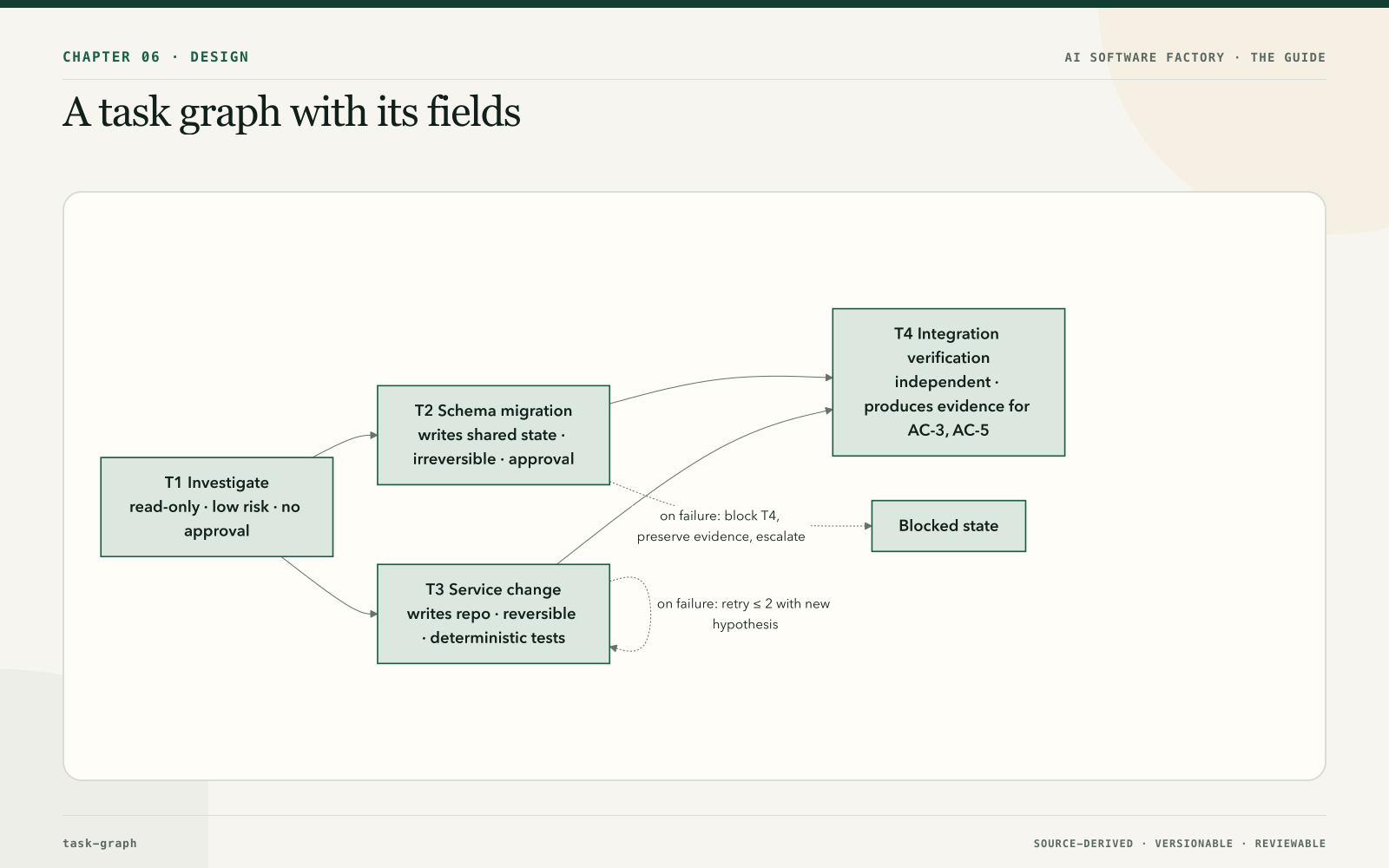
Two consequences are easy to miss. The first is that when two tasks modify the same repository, the problem is coordination of shared mutable state, which is a distributed-systems problem with leases, ordering, and conflict semantics, not a reasoning problem that a smarter model will solve (Chapter 14). The second is that decomposition is not a way of maximising the number of agents. Its purpose is to expose the shape of the work so that the platform can choose the cheapest reliable capability for each piece: a strong reasoning model for the ambiguous task, a small model for the mechanical one, a deterministic script for the transformation, a skill for the repeated pattern, and a human for the decision. A graph whose every node says "agent" has not been decomposed; it has been duplicated.
Decompose without losing lineage
Each WorkOrder projects a coherent subset of the approved Plan, and the projection must be traceable in both directions:
Mission requirement
  -> approved Plan decision
    -> WorkOrder acceptance boundary
      -> Task execution unit
        -> Attempt and artifact
          -> criterion-linked evidence
A WorkOrder must be independently understandable, bounded, authorised, and verifiable. Cross-WorkOrder invariants stay at the Mission or Plan level and require integration evidence, not the sum of unit evidence. A decomposition is invalid if local completion of every WorkOrder can still violate the global outcome. That is the test to apply: could all of these be accepted and the Mission still fail?
Baseline and change control
Approval creates a specification baseline: an immutable version with a canonical digest, author, approver, rationale, and effective time. A material change creates a new revision; it never edits history. When a revision is created, the system must determine which WorkOrders, Attempts, evidence, approvals, and release decisions are invalidated or need re-evaluation. Change a token expiry from fifteen minutes to five and the requirement, its criterion, its assertions, the tests that produced evidence for the old value, the WorkOrder that was accepted against them, and possibly a release gate all need to be reconsidered. If the system cannot enumerate that list, the baseline is decorative.
NASA's systems-engineering guidance is a useful discipline here, because it was written for exactly this class of problem: requirements should be clear, unambiguous, singular, traceable, and individually verifiable; verification shows conformance to specified requirements, while validation shows that the right product works in its intended environment. A factory needs both, and they are produced by different evidence.
Prototype as specification
There is a second route to a specification that is worth naming because senior practitioners increasingly use it for large, experimental work. Instead of writing the specification in prose and then implementing it, you build a rough prototype and use the prototype as the specification.
The workflow, as described by Dexter of HumanLayer on a livestream with BAML, runs like this. Research back and forth with a model until there is a product outline. Turn that into a set of interaction mocks, plain HTML mockups that need not be faithful, whose only job is to fix the direction. Then queue an overnight session: implement, review, have a second model review the first, compact, repeat, sometimes fifteen queued prompts letting the models argue it out. In the morning, a human looks at what was built, polishes the parts that matter, and fixes what is broken.
The result may be a twenty-thousand-line pull request. Nobody should review that, and nobody will do so at the same bar of quality; a reviewer handed it will resent it. So the large PR is not the deliverable. It is the slop PR, and its role is to be the spec. The next prompt is "treat this as the specification; if you were implementing it from scratch, how would you break it into digestible, incrementally shippable pieces, and where do the migrations go?" Models are good at this decomposition. The output is a sequence of pull requests of one to three thousand lines each, merged one at a time, with migrations ordered so each slice is safe on its own. In the reported case the first five slices shipped at roughly one a day; a colleague picked up the last three, disliked the architecture of one, and rewrote it, which was easy precisely because the slice was digestible.
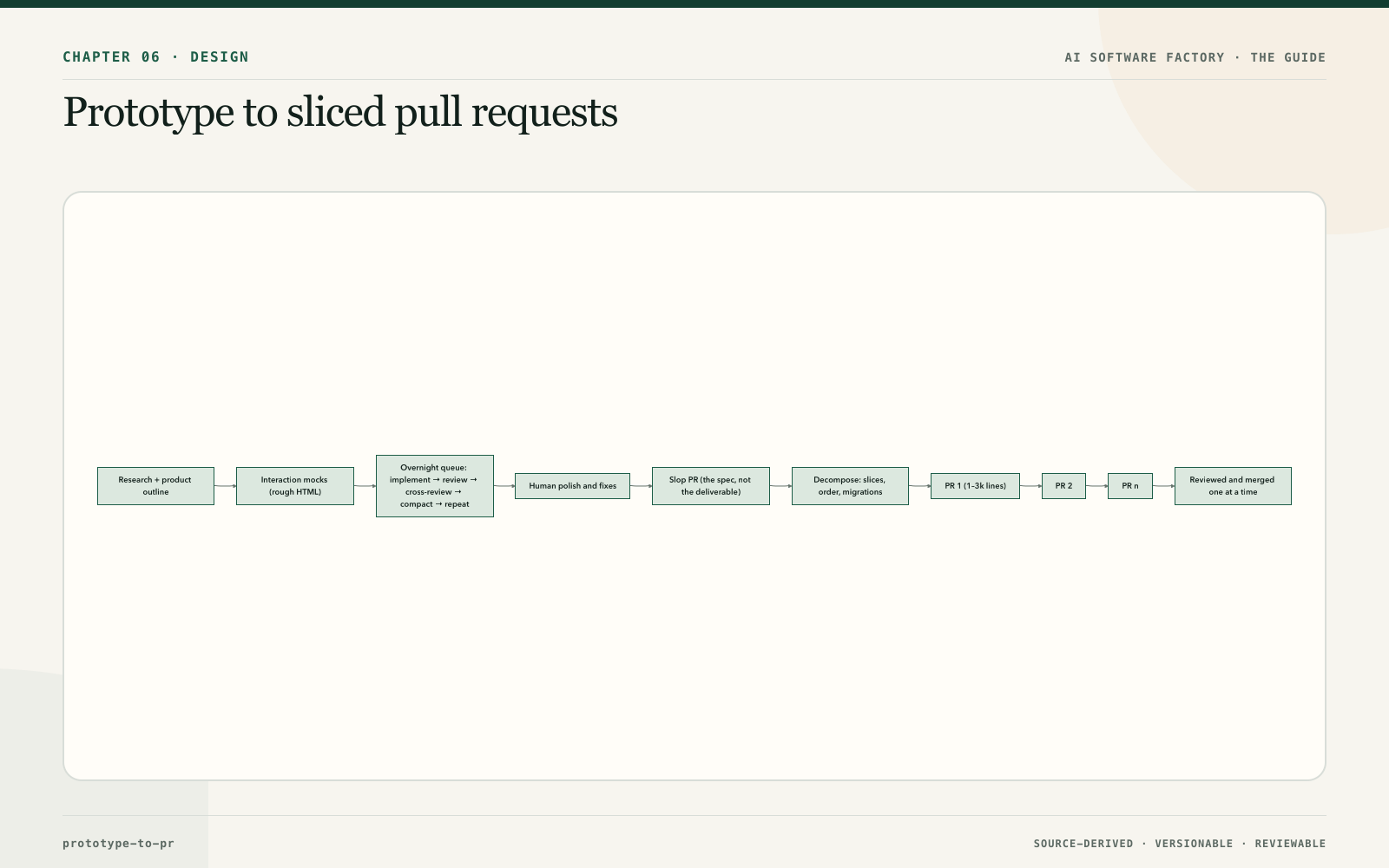
This is not a replacement for the governed path; it is a way of producing the Plan. The prototype phase is cheap in human time and spends tokens the team has already paid for; the engineering happens in the slicing and the review. Around ninety percent of what a team ships is small enough to do in one pass and does not need it. It earns its cost when the work is large, experimental, and the vision cannot be conveyed by mockups alone. In factory terms the slop PR is design input with agent provenance, the slice plan is the Plan submitted for review, and each slice is a WorkOrder with its own acceptance boundary and evidence. Everything Chapter 5 said about lineage and immutability still applies.
Risk-proportional depth
More specification reduces rework but delays learning and can create false precision. The answer is not a fixed template but risk-proportional detail: lightweight contracts for reversible, low-risk work; deeper requirements, threat analysis, and formal approval for consequential changes. "Executable specification" does not mean every business judgment becomes code. It means every advancement decision has explicit inputs, a responsible authority, and inspectable proof.
How to build it
Step 1 — Standardise intake. Accept intent from every source (objectives, customer problems, bugs, feature requests, incidents, security findings, reliability targets, debt) into one intake form that captures the requester, the raw statement, and the provenance of every constraint attached to it.
Step 2 — Draft the Mission contract. Fill the seven-item Mission list above. Assign stable IDs to every requirement so criteria, assertions, evidence, and findings can reference them. Classify risk and name the decision owners.
Step 3 — Write the four-layer specification. For each requirement, write the acceptance criterion, at least one validation assertion, and the evidence requirement (verifier, method, environment, artifact digest, freshness window). For every NFR, record measure, condition, population, threshold, and window. List the invariants separately at Mission level.
Step 4 — Specify failure first. For each dependency and transition: timeout, retryability, idempotency, cancellation, partial success, reconciliation, rollback, operator-visible state.
Step 5 — Run the assurance pass. Apply the nine-item ambiguity checklist, by hand and with an agent critic. Record findings as {severity, requirement_ids, rationale, proposed_resolution, owner, deadline}. A human accepts or rejects each finding; record which and why.
Step 6 — Produce the Plan. Require the nine plan contents (current state, relevant code, proposed changes, dependencies, risks, test strategy, rollback, cost and complexity, open questions). For large experimental work, consider the prototype-as-spec route and submit the slice plan as the Plan.
Step 7 — Review independently. A reviewer who did not produce the plan delivers a coverage matrix, findings, and one of approved / revision required / exception required. Freeze the approved version with digest, author, approver, rationale, and effective time.
Step 8 — Release WorkOrders with lineage. Each WorkOrder references the Plan decisions and requirement IDs it projects, carries only its own acceptance criteria, and inherits cross-cutting invariants by reference.
Step 9 — Wire invalidation. On any specification revision, compute and display the set of affected WorkOrders, Attempts, evidence, approvals, and release decisions before the revision is approved.
A minimal specification package for a small feature includes: stable IDs; UI, API, and schema behaviour; empty and whitespace cases; authorisation; backward compatibility; a browser-level assertion; the evidence method; risk; and rollback.
Failure modes
The invented "done". The agent's plan contains a definition of success nobody wrote. Detect it by requiring every acceptance criterion to trace to a human-approved requirement ID; anything untraceable is an agent-proposed assumption and must be labelled as such.
Activity criteria. Criteria that describe work ("add retry logic") instead of outcomes ("no duplicate PR is created under provider failure"). Detect with the "restates the requirement" and "cannot be observed" checks.
Unmeasured quality attributes. "Secure", "fast", "scalable" with no measure. Reject at assurance; an agent will satisfy these words by its own definition.
Local completeness, global failure. Every WorkOrder accepted, Mission unmet, because a cross-WorkOrder invariant lived nowhere. Keep invariants at Mission level with integration evidence.
Silent revision. A requirement edited in place, leaving old evidence looking valid. Enforce baselines; every material change is a new revision with computed invalidation.
Critic hallucination. The LLM critic proposes requirements nobody asked for and they are accepted as if they were stakeholder statements. Preserve provenance on every line.
Validator disagreement resolved by luck. Two reviewers disagree and the plan is regenerated until one passes. Escalate disagreement to a human decision owner instead.
The unreviewable prototype. A large exploratory PR is submitted as the deliverable. Treat it as the spec; require slicing into reviewable PRs with ordered migrations.
False precision. A low-risk, reversible change buried under a heavyweight process. Scale depth with risk; the process should be lighter than the change.
Efficiently solving the wrong problem. Material ambiguity ("which percentile? what regression tolerance?") is resolved silently and every downstream stage does good work on the wrong target. Detect it as rework whose root cause is "that is not what I meant"; correct it by extracting objective, constraints, context, criteria, and risk before planning and interrupting the builder when ambiguity changes implementation or risk.
The Plan as chain-of-thought. The plan exists only in the model's context, so nothing can be approved, diffed, or held against the work. Make the Plan a versioned record with the ten contract fields, and separate the replaceable planner from the governed Plan.
Decomposition that maximises agents. Every node in the task graph is an agent; coordination cost, tokens, and shared-state conflicts rise while quality does not. Use the graph to pick the cheapest reliable capability per node, including scripts and humans.
Platform-forward design. The entry point asks the builder to choose a model, name a harness, pick skills, or configure an MCP server before stating an outcome. Detect it in onboarding drop-off and in support questions about infrastructure rather than about work. Fix it customer-backward: the builder states the outcome, constraints, context, criteria, and risk; the factory resolves everything else.
One persona, five doors. The surface was designed for developers and every other builder is handed a developer's form. Detect it as non-developer intent arriving with empty scope and risk fields. Fix it with persona-specific surfaces that converge on one record set.
Adoption without transformation. Builder counts rise while the work itself is unchanged: agents type what developers used to type and developers still do everything else. Detect it in the human-outcomes metrics of Chapter 8. Fix it by measuring the builder journey through to end-to-end ownership, not just first use.
In Mission Control
Assessed at local HEAD a490648 against the main evidence boundary b31e275 (2026-08-11).
Implemented: draft Missions; versioned missionPlans; validation assertions; WorkOrder blueprints; plan submission, approval and rejection; revision forking; and atomic WorkOrder release, all in convex/missions.ts. The operator path is apps/mission-control-ui/src/eos/views/MissionPlanWorkspace.tsx. WorkOrders carry acceptance criteria and later connect to verificationReceipts in convex/schema.ts, with the contracts described in docs/software-factory/domain-contracts.md.
Not implemented on main: a general-purpose contradiction engine, a formal NFR schema, automated invariant analysis, or an independently enforced plan-assurance gate. This is a meaningful specification skeleton, not a specification compiler.
Design input only: a staged, uncommitted continuous-quality plan (SHA-256 31e3f6fc44824b643ef5bfa3389ba3da1e0e6b1f6827f66fdb63efcbb4c9313b) proposes treating the approved Plan revision as the top-level Quality Contract with WorkOrder criteria as scoped projections. It is a proposal, not capability.
Future direction: compile an approved Plan and the active Factory Configuration into a deterministic contract projection that emits coverage gaps, ambiguity findings, applicable controls, required evidence, approval owners, invalidation dependencies, and a canonical digest. Begin in observe-only mode, compare its findings with human review, then enforce one narrow WorkOrder-acceptance gate before expanding. The prototype-as-spec workflow is a practitioner pattern from outside Mission Control and is not a Mission Control feature.
Retain this
- The first hallucination happens before code — the system invents what "done" means. Business Understanding (the decision, constraints, ownership, success criteria) is the bottom layer everything else is built on; a governed, versioned, testable specification is the fix.
- Mission owns why, Plan owns how, WorkOrder owns a bounded, delegated part. Never let the "how" record rewrite the "why."
- A specification has four distinct constructs — requirement, acceptance criterion, validation assertion, evidence requirement — and two halves: what is wanted, and the verification contract that says, claim by claim, what counts as proof. NFRs need a measure, condition, population, threshold, and window; invariants live above the WorkOrder and must never become false.
- Separate intent understanding from planning: extract objective, constraints, context, acceptance criteria, and risk first, and interrupt the builder only when ambiguity changes implementation or risk. An agent efficiently solving the wrong problem is the most expensive failure a factory can produce.
- The Plan is a versioned, independently reviewed contract, not chain-of-thought: the planner is replaceable, the Plan is governed, approval freezes one exact revision, and it authorises release of WorkOrders rather than dispatching execution. Recheck the action against that frozen lineage immediately before an external effect. Decompose into a task graph whose nodes carry inputs, outputs, dependencies, risk, and verification, so the platform can pick the cheapest reliable capability for each piece.
- For large experimental work, a prototype can be the spec: mocks, an overnight implement-and-review loop, the resulting "slop PR" treated as the specification and sliced into small, ordered, reviewable pull requests.
- The Intent layer's customer is the builder. Design the Builder Experience customer-backward, so the builder never needs to understand the model, harness, skill, or MCP implementation, and measure adoption as workforce transformation, not a count of users.
Go deeper
- Previous: 5. Authoritative records for the records this chapter fills in. Next: 7. Governance, policy, and risk-proportional approval for how much process each risk class deserves.
- 25. The 12-layer production AI agent stack for Business Understanding in context; 26. Autonomous engineering workflows for the issue-to-PR path that consumes these specifications.
- 27. Quality and evidence architecture and 31. Quality contracts, proof packages, and certificates for what happens to assertions and evidence downstream; 28. Testing strategy for agentic change.
- 39. Production feedback, automated review, and the agentic merge queue for the merge side of the sliced-PR workflow.
- Glossary.
- External canon: NASA Systems Engineering Handbook, Appendix C and Product Realization; NASA SWE-055 Requirements Validation; NIST SSDF 1.1.
- Mission Control sources at the pinned commits:
convex/missions.ts,convex/schema.ts,apps/mission-control-ui/src/eos/views/MissionPlanWorkspace.tsx,docs/software-factory/domain-contracts.md,docs/plans/2026-08-11-feat-continuous-quality-proof-plan.md. - Source notes: "The 12-layer production AI agent stack" (Business Understanding layer); Jay West, "Key terms and definitions" capability taxonomy (Intent & Planning); Jay West, "AI Software Factory mission" (Intent layer and Planning layer); Jay West, factory architecture notes (five extractions from intent, the checkout-performance ambiguity example, plan contract and questions, task-graph fields, planner versus Plan, approval semantics, the builder layer: Builder Experience, personas, customer-backward design, the builder journey, workforce transformation); HumanLayer × BAML livestream, "Software factory design patterns" (Dexter of HumanLayer on the prototype-to-sliced-PR workflow); Arunkumar Palanisamy, public post and discussion on goal understanding and the real-world action boundary (accessed 2026-09-04); public practitioner talks, 2026 (work shaping, the Definition of Correct, the verification contract as part of a complete specification).