41. Meta-loops and the closed-loop factory
How a factory defined as code harvests corrections, evaluates its own proposed changes, and promotes them by action class without self-authorizing.
On this page7 sections
The closed-loop factory makes its own definitions diffable, scores real runs, harvests repeated corrections, and proposes the narrowest durable improvement. Meta-loops may discover and verify changes; promotion remains asymmetric by action class and authority changes never self-promote.
The problem
Learning systems fail when they optimize noisy signals, generalize personal preference into organizational truth, or let the loop change its own judge. Factory improvement therefore needs versioned baselines, scoped evidence, independent evaluation, explicit action classes, canaries, and rollback.
How it works
The closed-loop factory: factory as code, scorers, and benchmarks
One published pattern makes the six levels concrete, and its vocabulary is worth borrowing. Warp's description of a closed-loop cloud software factory starts from an engineering mindset applied to coding agents: every agent in the factory is tracked and measured against the organization's own data and workflows, not a leaderboard. The pattern has four parts.
The factory is defined as code. A factory manifest plus a directory of agent definitions, skills, MCP servers, and model-routing rules, version controlled and editable by agents as well as people, the way infrastructure is. That buys a measurable baseline ("with this configuration we merged this share of agent pull requests at this cost per pull request, routing across these models, with these skills"), version control with rollback, branching, approvals, and history, and the property the rest of the loop depends on: the factory becomes instantiable and testable, and an agent can propose a diff to it. In this guide's terms the manifest is the Factory Version of Chapter 11 written as a file, and the metrics it baselines (pull-request throughput, average cost per pull request, automation percentage as average human touchpoints per pull request, savings over human work) are the inner-loop economics of Chapter 8.
Scorers grade runs. A scorer is a function from an input (agent runs and traces, including the human interactions around them: pull-request comments, tracker input) to a grade against a rubric, and it can be graded by a human, by code, or by a model as judge. Default dimensions are correctness, cost efficiency, and verbosity. Scorers cost money to run, so each has a configured sampling rate, a cadence (every few hours, not every run), and a batch size. That is the observe-and-evaluate half of the seven-step loop, made explicit as a budgeted job rather than a dashboard.
Self-improvement agents propose diffs. They read the scored runs, find patterns in the failures and successes, and propose diffs to the factory definition. Humans review those diffs as pull requests and merge them. That is level 4 of the scale above, with the review at level 6 exactly where this chapter puts it: factory agents build, scorer agents grade, self-improvement agents suggest, humans review and merge factory-definition pull requests.
Benchmarks are configuration matrices. A factory benchmark is not an A/B test on live traffic. It picks five to ten representative reference tasks, from scratch or from past runs, varies the configuration (the model mix or any other factory primitive), runs the variants in parallel, grades them with the same scorers, and produces a results matrix; an agent then synthesizes the matrix into a diff that updates the affected primitive, such as the routing rules. The loop closes when that diff is reviewed and merged like any other.
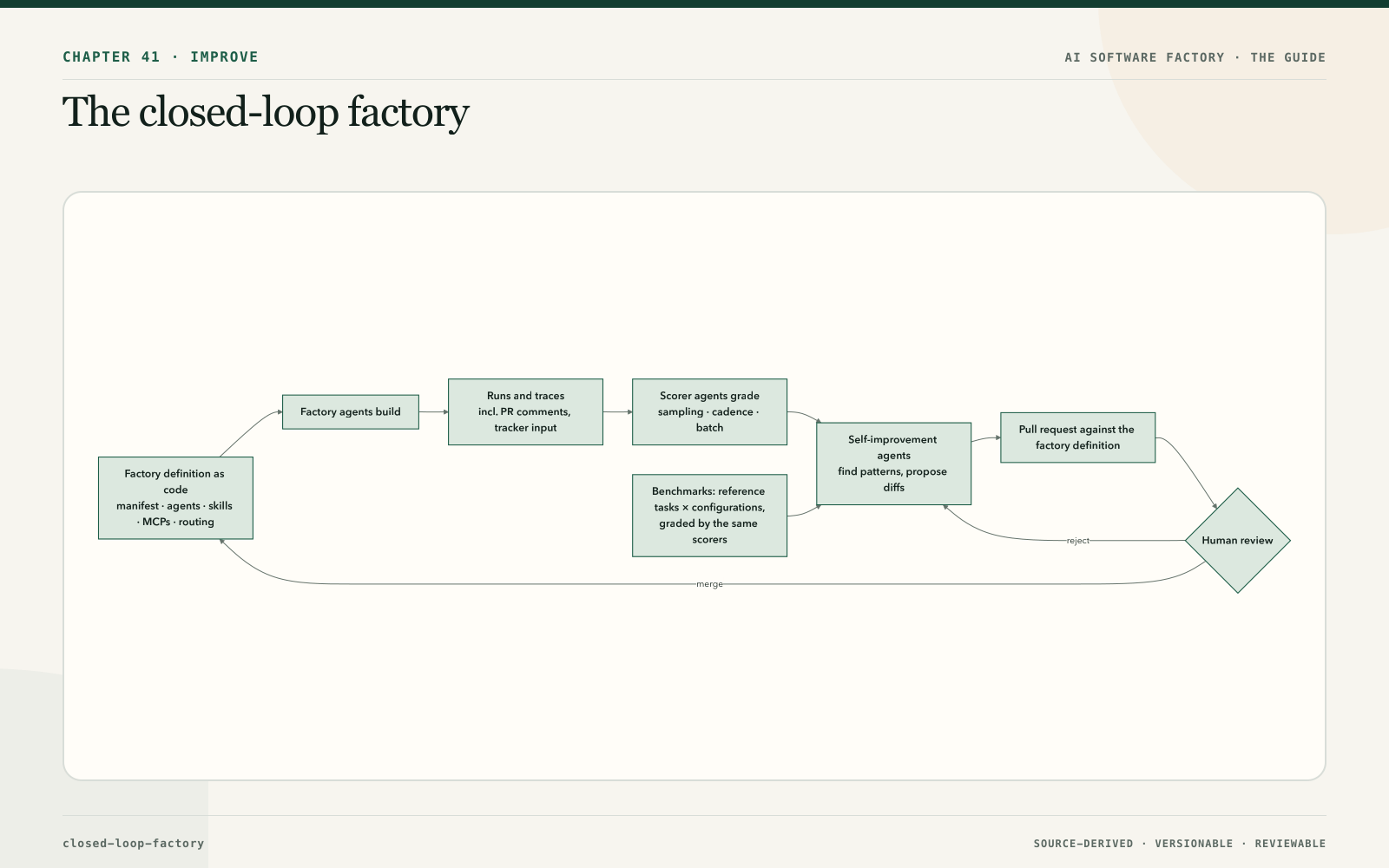
Read against this chapter, the pattern is the Factory Learning chain with a different surface: the scorer is the deterministic signal or the LLM-judge evaluator, the pattern-finding agent is discovery, the pull request is the Improvement Candidate, and the merge is promotion. What the pattern adds is the insistence that the factory itself be a diffable artifact, which is the precondition for an agent proposing a change to it, and the reminder that grading has a cost that must be sampled and scheduled like any other spend.
Eval-driven factory engineering
The pattern generalizes into a working rhythm for the people who own the factory: hypothesis → change → eval → compare → promote or reject. It is test-driven development applied to the factory. A hypothesis names the component and the expected effect ("adding the architecture verifier will cut review comments on layering by half at no more than a tenth more cost per run"); the change is made as a versioned candidate; the eval runs the reference tasks with and without it; the comparison reads the delta on quality, success, intervention, latency, tokens, and cost; and the outcome is promote or reject, recorded either way. The evaluation machinery (reference tasks, graders, the with-and-without discipline, statistical care, and the promotion ladder from offline to production) is Chapter 30's subject and is not repeated here; what this chapter adds is that every change to the factory, including the ones the factory proposes about itself, goes through that rhythm, and that a change without a hypothesis is an experiment nobody can learn from.
Compounding engineering: harvesting corrections
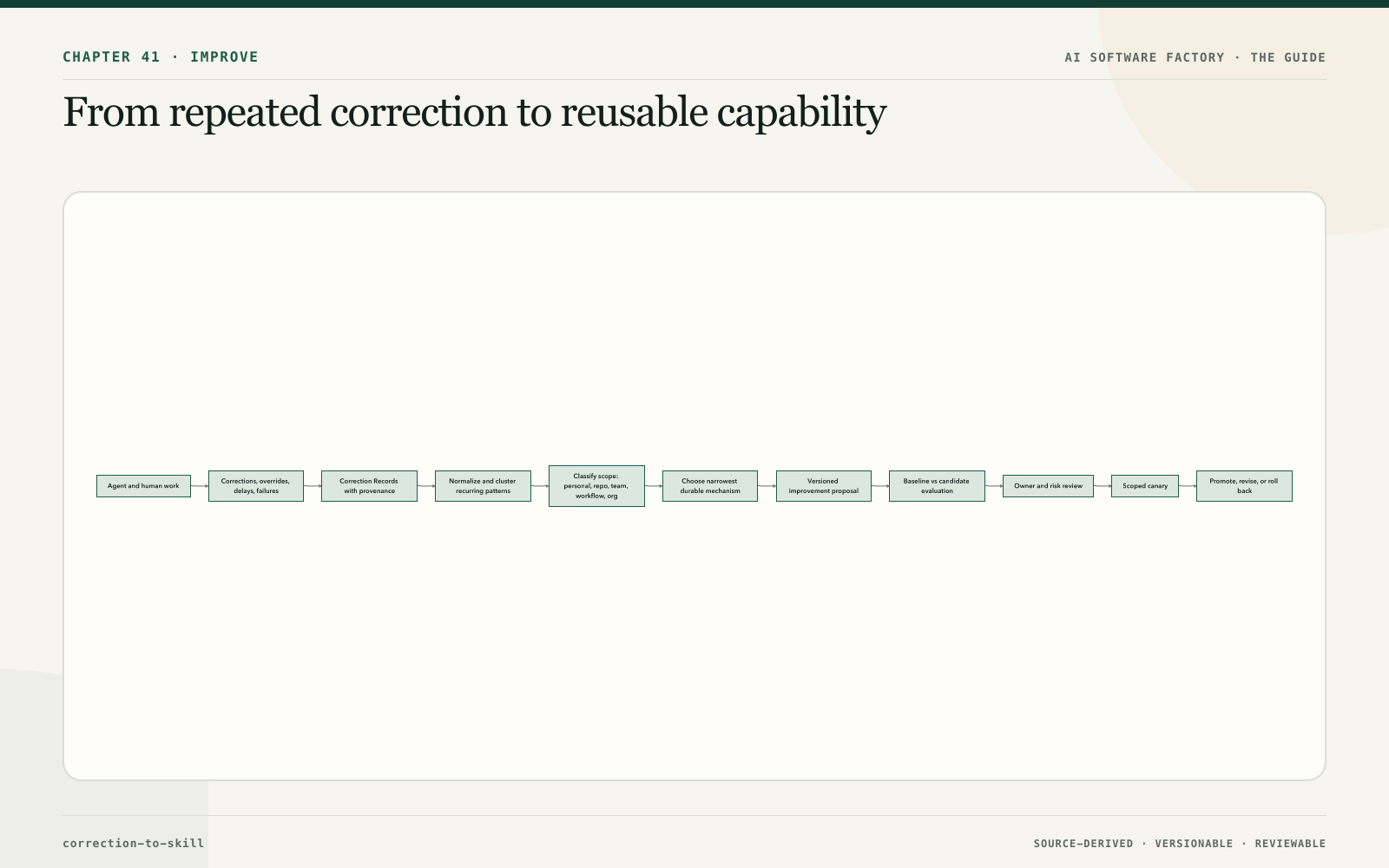
Compounding engineering is the practice of turning recurring, attributable human corrections and production outcomes into reviewed improvements to instructions, skills, tools, tests, context policies, workflows, documentation, or deterministic software. It operates below the broader learning loop above: it supplies concrete improvement candidates and never changes active behavior by itself. The control-plane framing from the "Software factory design patterns" conversation is the memorable version: if all your engineers are saying the same thing to the agent all day, how do you incorporate that into the outer harness?
A concrete example of the harvest, from one of the practitioners' own writing process: rather than accept three pages of generated prose, he has the model write two or three sentences at a time, edits them, tells it to read what he changed and do the next section without repeating the mistake, and after four or five iterations the session has learned a tone. He then flushes that tone out into a document listing the anti-patterns the model produces by default. That document is a harvested correction set — an anti-pattern catalog — and the next session starts with it instead of relearning it. The same shape applies to code: when judgment is dense (writing, design, architecture, ambiguous product work), short iterative increments calibrate better than one large generated artifact; the human supplies examples through edits, the agent applies the emerging pattern to the next bounded section, and once a pattern repeats it is extracted into a style guide, anti-pattern catalog, example set, or skill. When the work is mechanical with strong specifications and tests, larger autonomous increments are fine. Interaction granularity is a workflow design choice, not a universal preference.
Correction harvesting starts with a Correction Record containing:
- source Attempt, artifact, and exact before/after behavior;
- human actor and role;
- reason, affected criterion, and confidence;
- correction type: factual, procedural, stylistic, architectural, policy, safety, or outcome;
- proposed scope: personal, repository, team, workflow, or organization;
- sensitivity, retention, and consent;
- recurrence evidence and related incidents; and
- candidate destination such as test, instruction, skill, tool, or code.
Do not learn from acceptance alone. A reviewer may accept under deadline, fix the result silently, or miss a defect. Capture explicit corrections and the downstream outcomes — did the change fail in production, did a later reviewer undo it — because those are the signals that survive contact with reality.
Pattern mining then clusters the records: the same correction across ten engineers and three harnesses is one pattern with strong recurrence evidence, and recurrence is what earns a place in the proposal queue. The output of mining is skill extraction and codification — or, more precisely, a decision about which mechanism should hold the lesson. This is the feedback-to-skill loop, and the name is slightly misleading, because a skill is often the wrong destination.
Promote to the narrowest durable mechanism
Use the least probabilistic mechanism that solves the recurring problem:
| Repeated problem | Preferred durable mechanism |
|---|---|
| Formatting or syntax rule | Formatter, linter, schema, or deterministic test |
| Repository command or sequence | Versioned repository instruction or skill |
| Missing domain fact | Correct authoritative source and retrieval path |
| Repeated implementation mistake | Regression test, invariant, or library API |
| Review preference | Scoped review rule with precision measurement |
| Task-routing mismatch | Evaluated model or capability profile |
| Ambiguous product decision | Specification template or required human decision |
| Unsafe action | Policy, permission, or architectural boundary |
An instruction is not automatically the best answer. Repeatedly telling an agent not to violate a structural invariant is weaker than making the invalid state impossible or testable. The best improvement often removes an agent decision entirely — a rule becomes deterministic, a tool becomes clearer, the required context becomes reliably available. Compounding should make the next correction less likely, not merely make the next prompt longer.
Diagnose before optimizing
Outcomes are caused by interacting components. A failure blamed on the prompt may come from missing data, a confusing tool schema, the environment, a policy, or the evaluator. Successful behavior may rest on accidental context or hidden human help. So the learning system clusters related signals, tests causal hypotheses, and only then chooses the smallest durable remedy:
- deterministic code or policy for rules that should not remain probabilistic;
- prompt or Agent Definition change for reasoning and communication behavior;
- skill update for a reusable task method;
- tool change for missing or confusing capability;
- context or semantic change for unavailable or misunderstood knowledge;
- route change for capability, latency, availability, or cost mismatch;
- evaluator or dataset change for a measurement failure; or
- workflow change for incorrect decomposition, authority, or recovery.
Two of those remedies have names worth keeping. Prompt optimization is controlled experimentation that changes instructions or prompt composition to improve defined outcomes without widening authority; it requires holdout evaluation, regression controls, and versioned promotion, or it is just editing. Skill improvement is a governed update to a reusable task method based on diagnosed evidence, followed by evaluation, certification, promotion, and rollback planning. Whichever remedy the diagnosis selects, its output is a promotion recommendation: the evidence-backed suggestion that a validated improvement be adopted into the standing factory configuration. It remains a recommendation until a human with the relevant authority accepts it.
Learning from success needs the same care. Compare successful runs to matched baselines and identify the strategies associated with acceptance, low retry, low cost, low review effort, and safe recovery. Do not copy private data, incidental repository text, or one-off reasoning into standing instructions; a strategy that worked once because of an accident of context is not a pattern.
Skills that improve from their own traces
Skill improvement has a natural automation, and at least one large engineering organisation running thousands of skills has published it as its next step. Every skill execution leaves a trace, and the trace records the papercuts: the retry that was needed, the argument the skill got wrong, the tool result it had to re-fetch, the step a human corrected afterwards. Record those papercuts per skill, cluster them across executions, and auto-generate a proposed skill update from the traces, so the skill's own history writes its next revision. The same organisation's session analytics is moving in parallel from batch detection of anti-patterns (the dashboard of Chapter 8) to continuous trace monitoring that guides the engineer in real time, inside the session, before the expensive turn happens rather than in a report afterwards.
Both are discovery, in this chapter's terms, and both belong in the meta loop. What they are not, in this guide's model, is promotion. An auto-generated skill update is a versioned improvement candidate like any other: it carries its trace evidence and its recurrence count, it is evaluated against the current skill as baseline on a development set and an untouched holdout, it must clear the quality floor, and it goes live only through the promotion gate, as a bounded tuning or a capability change depending on what it touches. A skill that rewrites itself from its own traces without beating a baseline is the self-authorised mutation of the first failure-mode row, wearing a more sophisticated pipeline. Real-time guidance is safer, because it advises a person rather than changing a capability, but the advice is still derived from the anti-pattern catalog, and that catalog is versioned and evaluated like any other evaluator. Traces may propose; the gate promotes.
Mining corrections: from review history to durable assets
Skill traces are one mine. The richer one, in most organizations, is the pull request history, because every review comment that led to a diff is a correction with its evidence already attached. Public harness-engineering tooling now ships this as a read-only skill: read the PR review comments, review summaries, CI results, and the diffs that addressed them; categorize each correction into an improvement type; and propose a concrete next step. The output is a list of findings, not a change. That is discovery, in this chapter's terms, done against the record the factory already keeps.
The four improvement types are a decision table for where a fix belongs, and they refine the "narrowest durable mechanism" table above for the corrections that come out of review:
| Improvement type | Use it when the correction is | Example |
|---|---|---|
| Rule | An always-on convention the agent should never have to discover (eager push, Chapter 11) | "Use the shared HTTP client, never a raw fetch" |
| Skill | A multi-step procedure needed only for some tasks (lazy push) | The playbook for adding a CLI command end to end |
| Verifier | A binary, observable invariant on committed files that a judge can check | "Every component file exports an element with a test identifier" |
| Refactor | A structural change to the code that removes the temptation, paired with a rule or verifier so it stays removed | Extract the duplicated validation so there is one place to get it right |
The order of preference runs from the bottom of that table upward whenever the correction can be made deterministic: a verifier or refactor removes a class of mistake; a rule prevents it at some context cost; a skill teaches it on demand. The finding names its type, the evidence (the PR numbers where the correction recurred), and the proposed next step.
Then the improvement follows the ordinary path: file a ticket carrying the evidence, implement the rule, skill, verifier, or refactor as a versioned candidate, prove it with the with-and-without evaluation of Chapter 29 so the delta is measured rather than assumed, and keep the skill quality gate in CI. Schedule the scan weekly, with manual dispatch for after a large merge, and write its findings to an artifact the team reviews. The loop that results is the meta loop in one sentence: agents write code, the scan surfaces patterns, people improve skills and rules, agents get better.
A sibling scan mines the same history for chores instead of corrections. Read ninety days of pull requests for repeated manual work and coordination patterns (the dependency bump somebody does every Monday, the changelog someone always fixes, the cross-repository ping that precedes every release), classify each pattern as established or emerging, state why automating it is worth it, cite the evidence PRs, and suggest an execution mode: scheduled (a cron workflow) or triggered (on a PR event or label). That is find-automations, and it feeds the maturity lifecycle of Chapter 12 from the other side: work that is already deterministic should leave the reasoning budget entirely.
In this guide's model, every finding either scan produces is a governed candidate. A mined rule is not appended to the repository instructions because a scan suggested it; it is a versioned improvement proposal with recurrence evidence, it is evaluated with and without, and it goes live only through the promotion gate. The scan is allowed to be read-only precisely so that nobody has to trust it.
Meta-loops, maintenance loops, and discovery
The two scans above are instances of a general kind. A meta-loop is a loop whose subject is other loops: it observes, evaluates, diagnoses, and proposes improvements to the loops that do the factory's work. Seven are common enough to name, and a mature factory runs most of them on a schedule:
- a failure analyzer, which clusters run failures by the taxonomy and proposes the fix that removes the class;
- a cost optimizer, which finds the trajectories, routes, and context loads that spend without contributing;
- a context-drift detector, which finds instructions and skills that still describe the framework, architecture, or standard the organization has moved away from;
- a skill optimizer, which reads skill traces for papercuts and drafts the next revision;
- a verifier-quality monitor, which checks the verifiers against later outcomes so that a verifier passing bad work or failing good work is itself a finding;
- a routing optimizer, which reads the model × harness results and the workload distribution and proposes routing changes; and
- a factory-health monitor, which watches the autonomy, automation, quality, and economics figures for the trends the others should be asked to explain.
Every one of them is discovery. Every one produces candidates for the promotion gate, and the verifier-quality monitor deserves the strictest gate of all, because a loop that can change the judge can reward-hack the rest.
Beside the meta-loops sit maintenance loops: recurring workflows that keep software healthy without waiting for a backlog to prioritize them. Dependency upgrades, flaky-test repair, coverage, documentation, accessibility, security remediation, architecture conformance, dead-code removal, modernization, brand consistency, and debt reduction are all work that never competed well for engineering time and that a loop can do on a cadence with a verifier attached. The maintenance agent is the specialized agent that runs one of them, continuously monitoring and improving one dimension: test health, dependency health, documentation, architecture conformance, context drift, cost, readiness, security hygiene, flaky tests, technical debt. The ownership rule is the one to retain: humans own domains; agents maintain dimensions. A person is accountable for the payments service; a maintenance agent keeps its dependencies current across every service, and files its work through the same pull-request path as everything else.
Automation discovery is how new loops are found. Agents read the issues, pull requests, comments, logs, CI failures, and repeated commands of a repository, find the repeated pattern, and propose it as a candidate skill (if it is a method) or a candidate loop (if it is a recurring job with a trigger). The find-automations scan above is one implementation; the general rule is that anything a person does the same way three times is a candidate for a skill, and anything a skill does on a schedule is a candidate for a loop.
Workflow discovery is the same idea one level up. A workflow (the reason → retrieve → tool → observe → replan → execute → verify sequence an agent actually follows) is a versioned, evaluated artifact, and traces and evaluations will show that certain sequences reliably solve a class of task while others reliably do not. The cycle is discover → evaluate → encode → reuse: find the sequence in the traces, evaluate it against the class on reference tasks, encode it as a canonical workflow with its specializations by organization, product, and repository, and reuse it wherever the class recurs. That is how a factory ends up with a small library of proven workflows rather than a hundred thousand unrelated ones, and every encoded workflow enters through the same gate as a skill.
Scope: personal fit versus organizational truth
Corrections occur at different scopes. "Use this tone in my draft" is a personal preference. "Run this repository's generated-code check" is a local procedure. "Never let an executor hold publication credentials" is an organizational control. Treating them as one kind of memory creates conflict and unsafe promotion, so the Correction Record's scope field is a gate, not a tag: a personal preference may not become a team rule without the same evidence and review as any other proposal, and it must never grant tools, change policy, lower a quality gate, or alter business authority. Local preferences live only inside organizational policy and quality boundaries. The mechanism for holding personal fit — the Human Workflow Profile — and the human-attention accounting that goes with it belong to Chapter 8; here the rule is simply that scope is classified before anything is proposed.
Baseline, candidate, and the promotion gate
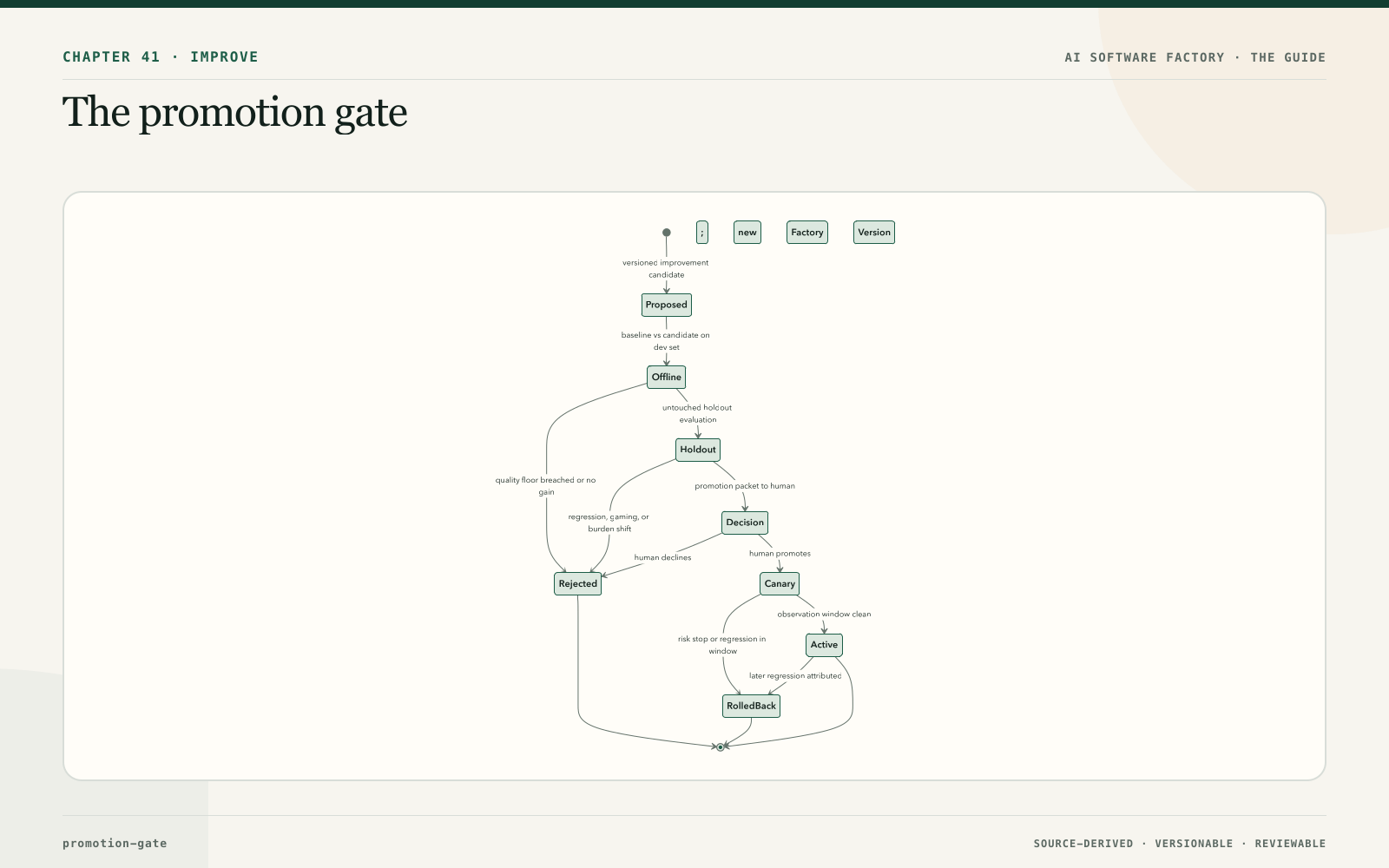
An improvement experiment defines baseline, candidate, comparable cases, primary metric, quality floor, risk stop, budget, observation window, and rollback. Faster or cheaper is not improvement when validation, security, reliability, or human attention worsens; the quality floor is the set of metrics that may not move down regardless of what the primary metric does. Offline evaluation precedes any canary, and offline evaluation itself is split: a development set the candidate may be tuned against, and an untouched holdout it may not, because automated prompt search will explore more candidates than a person could and will overfit the evaluator if allowed to see it.
Regression control means running broad regression, adversarial, security, policy, cost, and human-factor suites against the candidate — not just the metric the proposal was written to improve — because regression suites guard the whole capability graph, not one component. Watch specifically for reward hacking: metric gaming, longer hidden work that moves cost off the measured path, evaluator agreement without real correctness, and improvements that shift burden onto reviewers or production. A metric improvement can raise total human cost, and that counts as a regression.
Promotion is human-owned and creates something new: a new immutable capability version and a new Factory Version. It never edits historical runs, so any past decision can be replayed against the configuration that made it. After promotion, a bounded canary and an observation window follow, with automatic stop on risk. Offline evaluations are reproducible but may not represent production; online canaries are realistic but expose users and systems. Use staged evidence and strict risk ceilings, and let the canary window be the final vote.
Two more rules close the loop. Frequent optimization adapts quickly and creates version churn, so batch low-severity signals and escalate critical ones immediately. And autonomy is calibrated from outcomes: sustained validated outcomes may make a factory, a capability, or a workflow eligible for greater autonomy, while critical violations, fabricated evidence, security escapes, or repeated failure should demote or quarantine it automatically. Demotion can be automatic; promotion stays with a person.
Asymmetric autonomy per action class
"Promotion stays with a person" is the safe default, and it is also too coarse to hold for long, because it makes a one-point change to a retrieval parameter wait in the same queue as a change to tool permissions. The refinement is asymmetric autonomy: the level of autonomy is defined per action class, by reversibility and blast radius, not as one setting for the system. The question that sets the level is never "how confident is the model?" It is "what happens if this is wrong, and how easily can we reverse it?"
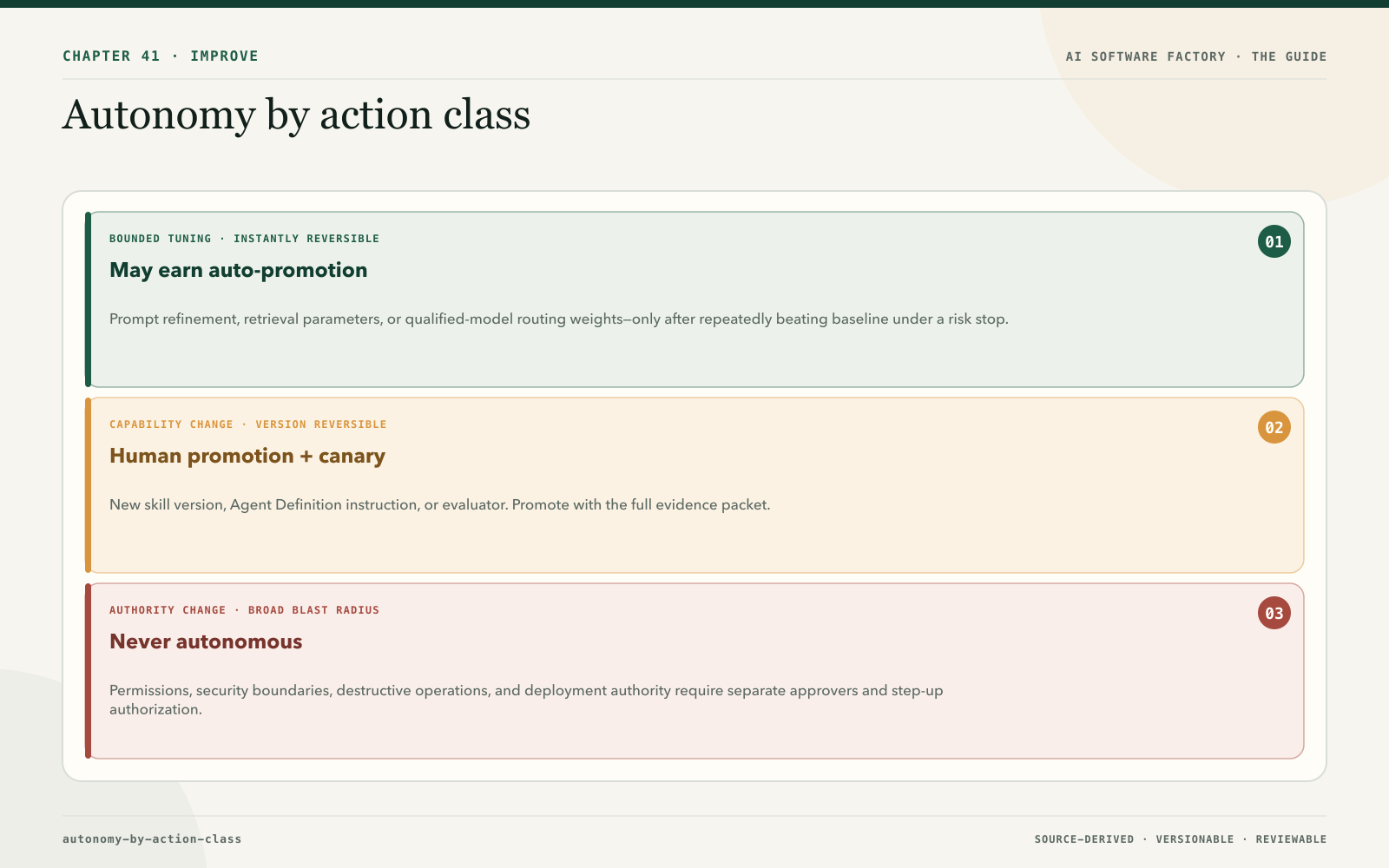
| Action class | Examples | If wrong | Autonomy |
|---|---|---|---|
| Bounded tuning | A prompt refinement inside a fixed template; a retrieval parameter; a routing weight between two qualified models | Quality dips on a slice; instantly reversible | May auto-promote after repeatedly beating baseline, if low-risk and under a risk stop |
| Capability change | A new skill version; an Agent Definition instruction change; a new evaluator | Behaviour changes across a workflow; reversible by version | Human promotion with the full packet; canary |
| Authority change | Permissions, security boundaries, tool authority, destructive operations, deployment authority | Blast radius outside the factory; may not be reversible | Never autonomous; separate risk class, separate approvers, step-up authorization |
The first row is where autonomy is earned back cheaply, and it should be, or the learning loop spends its human budget on trivia. The third row does not move with confidence, evidence, or track record; a routing weight that has beaten baseline a thousand times still says nothing about whether the system should be allowed to widen its own permissions.
The boundary with reward modeling
Everything in this chapter is learning in the engineering sense: production feedback and evaluation signals (acceptance, edits, preferences, evaluation outcomes, production behaviour) used to improve routing, prompts, skills, and evaluators. A team that runs it well will eventually be tempted by the next step: preference pairs, a reward model, fine-tuning against the factory's own outcomes. Those techniques are real, and the people running the loop should understand them, including their failure modes of reward hacking and distribution shift. But the upstream problem comes first, and it is the one this chapter is about: generating trustworthy learning signals from real workflows, with attribution good enough that the signal means what it appears to mean. Sophisticated optimization against noisy or poorly attributed feedback does not fail gracefully; it learns the wrong thing faster. A factory whose edit-size signal is polluted by reformatting, or whose acceptance signal is polluted by deadline approvals, should fix the signal before it fine-tunes anything on it.
The adaptation ladder
The narrowest-durable-mechanism table above chose a remedy per problem. Seen from the other side, the remedies form a ladder, ordered by how much of the system each one changes, how reversible it is, how much evidence it needs, and how hard it is to attribute a later failure to it. The adaptation ladder runs Rules → Retrieval/Context → Prompt → Skill → Routing → Fine-tuning → Preference optimization and training, and the rule for climbing it is the whole point: never jump straight to training.
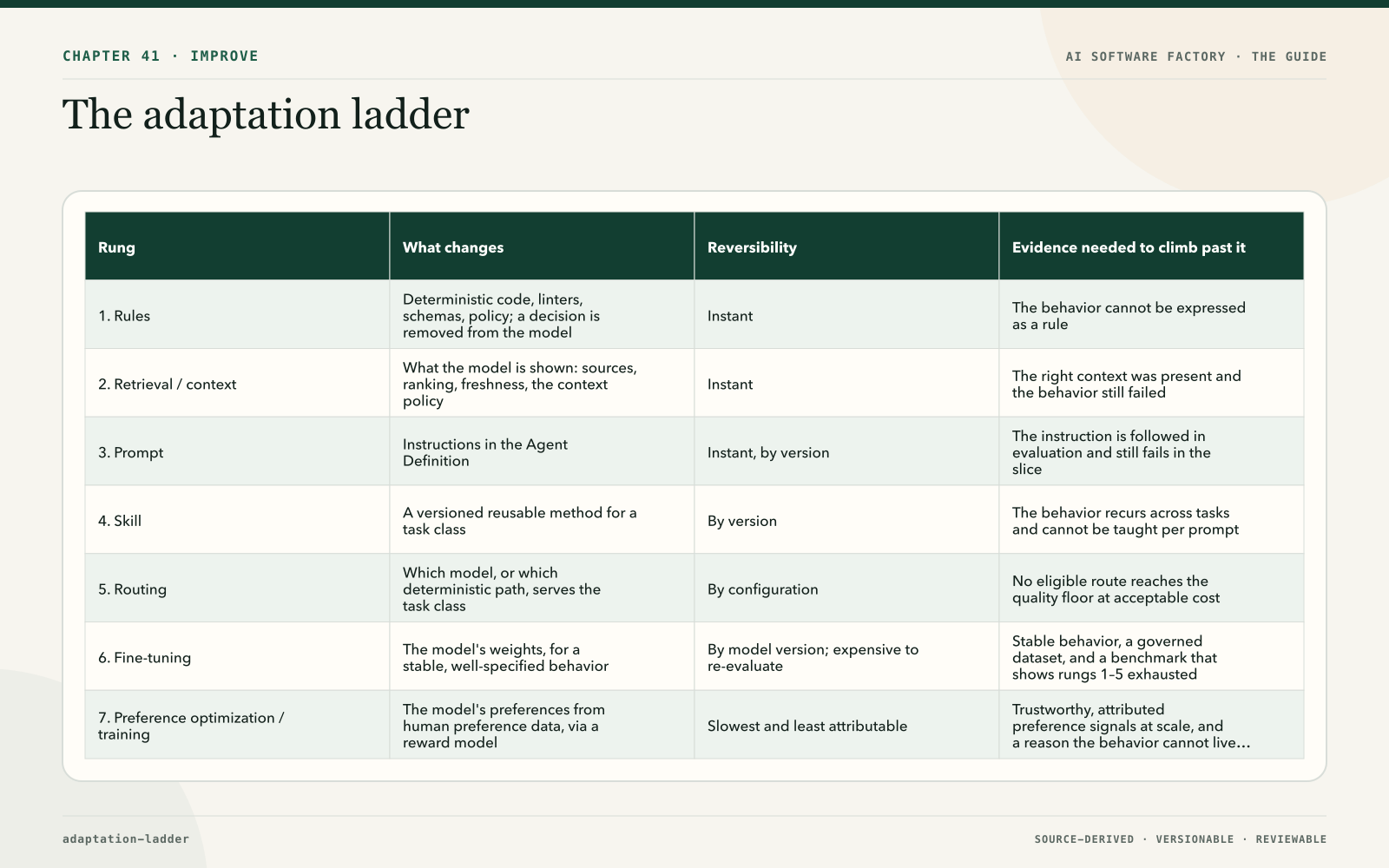
| Rung | What changes | Reversibility | Evidence needed to climb past it |
|---|---|---|---|
| 1. Rules | Deterministic code, linters, schemas, policy; a decision is removed from the model | Instant | The behavior cannot be expressed as a rule |
| 2. Retrieval / context | What the model is shown: sources, ranking, freshness, the context policy | Instant | The right context was present and the behavior still failed |
| 3. Prompt | Instructions in the Agent Definition | Instant, by version | The instruction is followed in evaluation and still fails in the slice |
| 4. Skill | A versioned reusable method for a task class | By version | The behavior recurs across tasks and cannot be taught per prompt |
| 5. Routing | Which model, or which deterministic path, serves the task class | By configuration | No eligible route reaches the quality floor at acceptable cost |
| 6. Fine-tuning | The model's weights, for a stable, well-specified behavior | By model version; expensive to re-evaluate | Stable behavior, a governed dataset, and a benchmark that shows rungs 1–5 exhausted |
| 7. Preference optimization / training | The model's preferences from human preference data, via a reward model | Slowest and least attributable | Trustworthy, attributed preference signals at scale, and a reason the behavior cannot live in rungs 1–6 |
The bottom of the ladder holds the mechanisms that do not touch the model at all, and most recurring problems are solved there. Rung 1 makes a decision deterministic; rung 2 changes what the model sees; rung 3 changes what it is told; rung 4 packages a method it can be handed; rung 5 changes which model answers. Each of these is a configuration or artifact change, promotable and reversible on the fast or medium release clock, and each failure they cause can be attributed by diffing two runs' lineage.
The top two rungs change the model itself, and they are where the vocabulary of machine learning enters the factory. Fine-tuning updates a model's weights on a governed dataset so that a stable behavior no longer has to be re-taught in every context window; adapters are the cheaper form, a small set of additional weights trained on top of a frozen base so that the tuned behavior can be attached, versioned, and detached without retraining the whole model, which is also what makes the base model replaceable underneath it (Chapter 21). Domain-level tuning applies this to a body of knowledge or convention that is stable across a product line, a code style or a domain vocabulary, and is the most defensible use, because the thing being learned changes slowly. Behavioral adaptation applies it to how the model acts (how it plans, when it asks, how it reports uncertainty) and is harder to specify, harder to evaluate, and easier to get subtly wrong. Preference optimization goes one step further: rather than examples of correct output, it learns from human preference data (pairs of outputs with a judgment about which is better), either directly or through a reward model trained to predict that judgment; RLHF, reinforcement learning from human feedback, is the best-known family of such methods. The factory's acceptance, edit, override, and dismissal signals are exactly the raw material these methods consume, which is why the previous section insisted that the signals be trustworthy first.
Three things follow. First, the ladder is climbed one rung at a time, with the evidence in the last column: a problem that reaches rung 6 should carry a record of why rungs 1 through 5 were tried and were not enough, because a behavior that could have been a rule and became a fine-tune is now unattributable, slow to reverse, and bound to one model version. Second, the upper rungs change the release clock: a tuned model or an adapter is an artifact with its own evaluation benchmark, certification, and rollback, and a preference-optimized model is a training run whose inputs (the dataset version, the reward model version, the experiment manifest) are governed records the learning system hands to specialists, never raw traces (Chapter 2). Third, the ladder is a diagnosis tool in reverse: when a team proposes training, ask which rung the problem actually lives on. Most of the time the answer is lower, cheaper, and reversible by lunchtime.
The factory flywheel
Put every loop in this chapter end to end and the factory has one shape, which is the reason to build any of it. Intent becomes a Definition of Correct (what good looks like for this task, repository, or domain, written down well enough that an agent and a verifier can both reason about it); the definition becomes context; context is packaged into a skill; the skill is executed; execution produces evidence; a verifier judges the evidence; the judgment is evaluated against the outcome; the outcome is learned from; and the learning improves the skill and the context for the next turn.
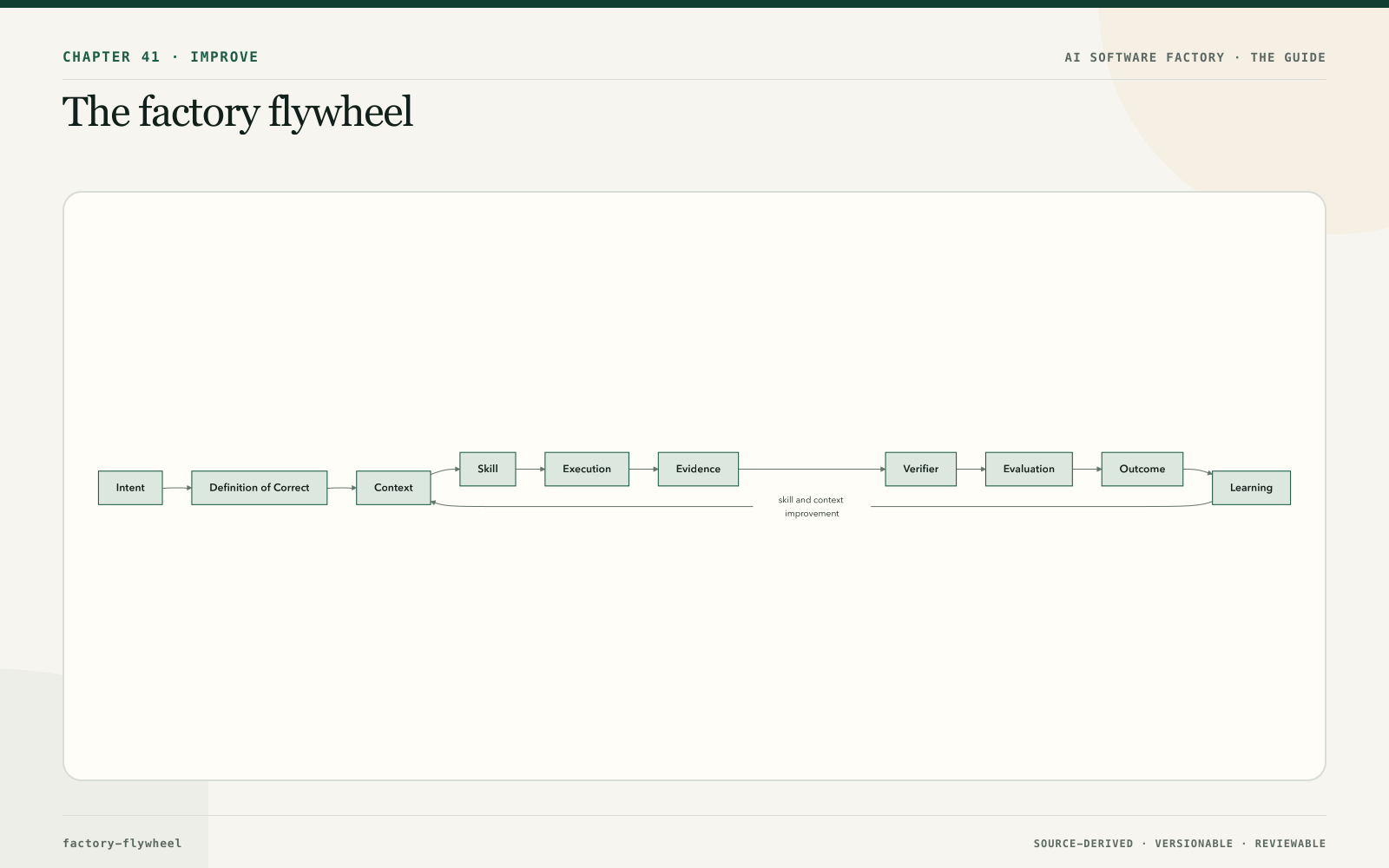
The flywheel is a confidence spiral: higher quality earns higher autonomy, higher autonomy produces more runs, more runs produce more evidence, more evidence produces better context, better context produces better skills, better skills produce better verification, and better verification produces higher quality. Every loop in this chapter is a bearing on that wheel, and the promotion gate is the brake that keeps it from spinning on a false signal.
What not to build first
The loop described here is the last thing a factory should build, not the first. Sophisticated autonomous learning before a trustworthy baseline exists optimizes against noise; ML-based routing before evaluation data exists routes on folklore; a universal memory layer before context governance exists is a stale-truth generator; hundreds of generic skills before one workflow runs end to end are hypotheses wearing version numbers. The order that works is the one the promotion gate implies: first a representative golden evaluation set (real tasks, known failures, adversarial and high-risk cases, previously escaped defects), because without a stable baseline, improvement becomes anecdotal; then observability and lineage good enough to attribute a signal to a source; then the discovery half of the loop, proposing to humans; and only then, per action class, the autonomy of the first table row. Do not generalize before you have earned the abstraction.
How to build it
Build the meta loop as ordinary governed engineering pointed at the factory.
- Build the golden evaluation set first, and the lineage that attributes a signal to a source. No autonomous learning before both exist.
- Define the learning-signal schema using the mission's eight questions plus source, subject, severity, attribution, evidence, and uncertainty. Ingest from workflow failures, validator disagreement, review findings, human edits to agent output (with edit size), unnecessary tool calls, expensive trajectories, tool failures, retrieval contribution, production defects and rollbacks, incidents, cost anomalies, builder feedback, and low-attention successes.
- Register sources. Every research or memory input gets identity, retrieval time, content hash, classification, license, sensitivity, and provenance; adapters are read-only; content never carries instructions.
- Harvest corrections with the Correction Record fields, under a consent and retention policy, capturing only what serves a defined improvement purpose and letting users inspect or challenge derived preferences.
- Cluster and diagnose. Group by pattern; record recurrence evidence; test causal hypotheses across data, tool, environment, policy, and evaluator before blaming the prompt.
- Classify scope (personal, repository, team, workflow, organization) before proposing anything; personal never promotes to organizational without evidence and review.
- Choose the narrowest durable mechanism from the table above; prefer deterministic code, tests, and schemas over instructions.
- Write the improvement candidate: hypothesis, affected components, baseline, expected benefit, risk, dataset, metrics, guardrails, scope, rollback, owner; plus why it exists, what evidence supports it, and what would falsify it.
- Evaluate offline against baseline on a development set and an untouched holdout; run the full regression, adversarial, security, policy, cost, and human-factor suites; check the quality floor.
- Materialize accepted proposals as governed work — a Mission or WorkOrder with the same execution, validation, evidence, and release rules as customer software.
- Promote by human decision into a new immutable capability and Factory Version; never mutate historical runs or live configuration in place. Define autonomy per action class: bounded tuning may auto-promote under a risk stop; capability changes need a human; authority changes never self-promote.
- Canary with a risk stop and observation window; roll back or demote automatically on regression; retain, revise, or roll back at the end.
- Measure the loop itself: which corrections recur, how much human time they cost, which improvement reduced them, and whether the change harmed quality or created new friction. If you cannot measure the agent, you cannot improve it.
Promotion packet checklist:
- Proposal version, owner, scope, and the mechanism chosen (and why not a narrower one).
- Baseline and candidate results on development and holdout sets, with the quality floor and every gated suite reported.
- Evidence list with provenance; contradictions and falsifiers stated.
- Blast radius, canary plan, risk stop, observation window, rollback.
- Who promoted it and when; the Factory Version it created.
Automatic demotion triggers: critical policy violation, fabricated evidence, security escape, quality-floor breach during canary, repeated failure above threshold.
Failure modes
| Failure | How to detect it | What to do |
|---|---|---|
| Self-authorized mutation (prompt or memory edited from feedback) | Behavior change with no proposal or promotion record | Route every change through proposal → evaluation → human promotion |
| Self-confirming evidence | Proposer and evaluator share identity or context | Independent evaluation; untouched holdout; separate verifier |
| Memory or research poisoning | Instructions or tool calls appearing inside source content | Untrusted-input handling; provenance; content never grants authority |
| Personal preference promoted to org rule | Scope missing or skipped on the record | Scope classification gate; separate review for scope escalation |
| Learning from acceptance alone | High acceptance, unchanged correction rate | Capture explicit corrections and downstream outcomes |
| Blaming the prompt | Repeated prompt edits for the same failure | Causal diagnosis across data, tool, environment, policy, evaluator |
| Prompt bloat instead of determinism | Growing instruction length, same failures | Narrowest durable mechanism; convert to test, schema, or code |
| Evaluator overfitting | Dev-set gains, holdout flat or worse | Untouched holdout; controlled search; human promotion |
| Reward hacking | Metric up, hidden work or reviewer burden up | Human-factor and cost suites in the gate; treat burden shift as regression |
| Faster-but-worse promoted | Primary metric improves, quality floor breached | Quality floor is a hard gate regardless of primary metric |
| Version churn | Constant Factory Version changes for minor signals | Batch low-severity; escalate critical immediately |
| Canary without a stop | Regression observed, canary continues | Risk stop with automatic rollback; observation window enforced |
| Historical runs edited | Replay disagrees with recorded decision | Promotion creates new versions only; history immutable |
| Surveillance instead of learning | Corrections captured without purpose or consent | Capture minimally; consent and retention policy; user inspection |
| Learning debt | Same correction cluster recurring across teams for weeks | Measure recurrence and human cost; prioritize harvest by cost |
| Autonomy never earned or never lost | Trust level static despite outcomes | Calibrate from validated outcomes; automatic demotion, human promotion |
| One autonomy level for the whole system | Routing tweaks queue behind permission changes, or permission changes ride a tuning fast-path | Define autonomy per action class by reversibility and blast radius |
| Optimizing against noisy signals | Fine-tuning or reward modeling on unattributed acceptance and edit data; behaviour drifts confidently | Fix attribution and signal quality upstream; learn the wrong thing slower, not faster |
| Autonomous learning before a baseline | Improvements are anecdotal; no golden set; regressions undetectable | Build the golden evaluation set and lineage first; propose to humans before automating anything |
| Listening only to explicit feedback | Signals come from a handful of vocal reviewers; quiet dismissals and later incidents are never joined to the findings they concern | Capture implicit behavior signals (comment acceptance, override, dismissal, later incident) and join them to records and outcomes |
| Unversioned failure taxonomy | Clusters are labeled ad hoc per team; the same cause has five names and no trend | Version the taxonomy, classify by cause, share it across teams |
| Candidate treated as controlled | A proposal is promoted on its own evidence without regression, shadow, A/B, or canary | Every candidate passes Verify in order; no instrument substitutes for the one before it |
| Jumping straight to training | A behavior that could have been a rule or a retrieval fix is fine-tuned; the failure is now unattributable and bound to one model version | Climb the adaptation ladder one rung at a time and record why each lower rung was insufficient |
| Preference data without provenance | RLHF or a reward model trained on acceptance signals polluted by deadlines and reformatting | Hand specialists governed dataset versions and experiment manifests, never raw traces; fix signal quality first |
| Model in the signal path | Refreshing the learning view spends inference; a model decides which failures count | Signals are deterministic over persisted evidence; zero model calls on refresh |
| Candidate from one occurrence | The queue fills with single failures dressed as patterns | Cluster by the versioned taxonomy; require a policy-set minimum occurrence count (three is a reasonable default) before a candidate |
| Candidate with authority | An Improvement Candidate edits live configuration or satisfies a receipt | Four human verbs only (approve experiment, snooze, dismiss, reject); recommendations enter as a Mission |
| Engine lessons trusted | An engine's lessons store is written into instructions or counted as evidence | Read-only after terminal success; additive candidates; telemetry that cannot accept or satisfy receipts |
| Writeback after failure | Lessons from a failed or cancelled run become candidates | Read the store only after terminal success by default; if failed-run lessons are admitted, label them unverified and isolate them from successful-run candidates; missing store means no candidates |
| Self-improvement agent merges its own diff | A factory-definition change lands with no human review record; level 6 reached by default | Self-improvement agents open pull requests; a policy-named approver merges; autonomous proposal is never autonomous promotion |
| Factory not diffable | Agents, skills, routing, and MCP configuration live in a UI or in scattered settings; no baseline, no rollback, nothing an agent can propose a change to | Define the factory as code: a versioned manifest plus definitions; every change is a diff |
| Scorer without a budget | Every run is graded on every dimension by a model judge; grading spend rivals building spend | Configure sampling, cadence, and batch size per scorer; use code and rules where the claim is deterministic |
| Recommendations nobody implements | The factory stops at level 3; a backlog of findings grows and the same failures recur | Move to level 4: open the pull request with evidence attached, so the human decision is review, not implementation |
| Meta-loop that can change the judge | A verifier-quality monitor or skill optimizer edits the verifier or evaluator it is measured by | Evaluator and verifier changes take the human path with a separate approver; no loop promotes its own judge |
| Maintenance loop without a verifier | A dependency-upgrade or dead-code loop merges on green CI alone; regressions surface weeks later | Every maintenance loop pairs with an independent verifier and the same risk classification as human-initiated change |
| Missing memory layer | Each run rediscovers the failure the last run hit; context never retains historical failures or successful patterns | Build the memory layer: repository profiles, failure history, the golden set, promoted learnings, with provenance |
| Workflow encoded from one trace | A sequence that worked once is promoted as the canonical workflow for a class | Discover in traces, evaluate on reference tasks for the class, then encode; specialize by layer rather than by copy |
In Mission Control
Two study commits are relevant. GitHub main at
b31e275
contains Loop Engineering, graph workflows, context evaluations, meta-loop
suggestions, verifier records, workflow-failure signal ingestion, and human
conversion of accepted suggestions into governed WorkOrders and Tasks; the graph
workflow has browser evidence for explicit dispatch, DAG visibility, failure
containment, and terminal human approval boundaries. Study commit
9d5f8e3
(PR #64) adds Phase 0 controls for governed continuous learning and proves, in an
isolated canary, atomic ownership, pause/drain modes, budget admission,
heartbeat, stale recovery, reasoned retry, cancellation, quarantine, independent
verification, and operator-visible Task semantics. Continuous scheduling stayed
off, the preserved Research Lab queue was not mutated, Phase 1 still needs a
governed source registry and ingestion policy, and the broader plan remains
proposed.
At
d902fae,
Mission Control additionally has human decision rights, risk-proportional
approvals, exception-first operator doctrine, decision packets, deterministic
learning signals, failure clusters, improvement candidates, datasets,
experiments, skills, context evaluations, canaries, human promotion boundaries,
recursive-improvement boundaries, trust changes, and versioned configuration,
and identifies prompts, skills, tools, context, routing, evaluators, and
deterministic controls as improvement targets. The Research → Verify →
Recommend → Approve → Implement → Validate → Measure → Iterate sequence is
Mission Control's stated design for the loop, with the improvement-candidate,
experiment, and human-promotion records above as its implemented substrate;
the full sequence running unattended end to end is not demonstrated, and
per-action-class auto-promotion of bounded tuning is a design position rather
than a shipped control.
The repository glossary and lexicon reviewed 2026-09-02 state the Factory
Learning chain (persisted evidence → deterministic signal → recurring cluster
→ Improvement Candidate → human review → experiment → Mission → Plan →
WorkOrder), the three-occurrence threshold, the four review verbs, the
zero-model-call refresh, the EVAL_SCENARIO recommendation with PR lineage,
and learning writeback from an execution engine's lessons store as contract.
The Production Factory Pilot V3 evidence in
Chapter 42 shows Factory
Learning producing one PROPOSED candidate with automatic promotion
disabled; writeback belongs to a flag-gated experimental adapter that is off
by default, so it is contract, not retained evidence.
What the evidence does not establish: a production correction-harvesting pipeline, scoped Human Workflow Profiles, anti-pattern extraction, automatic suggestion of deterministic replacements, cross-team correction recurrence, end-to-end attention accounting, a complete optimization service, success-pattern analysis, prompt or tool experimentation, holdout protection, automated regression attribution, or promotion and rollback across the capability registry. Mission Control has a governed improvement substrate, not a self-operating learning factory.
Retain this
- Define the factory as versioned code so every proposed change is diffable, evaluable, and reversible.
- Promote repeated corrections to the narrowest durable mechanism: code, test, schema, policy, context, skill, route, then training.
- Meta-loops may recommend and verify; no loop changes its own evaluator, authority, or promotion gate.
- Autonomy is set by reversibility and blast radius per action class, never by model confidence.
- Every candidate competes with the baseline through regression, shadow, canary, observation, and rollback.
Go deeper
- Chapter 3 — First principles: trust, evidence, and authority for autonomy levels and earned trust.
- Chapter 8 — Economics, metrics, and human attention for Human Workflow Profiles, attention budgets, and the human-attention half of compounding engineering.
- Chapter 11 — The Agent Factory for capability evaluation, certification, promotion, and retirement.
- Chapter 23 — Agent and loop engineering and Chapter 25 — The 12-layer production AI agent stack for Loop Engineering and the Continual Learning layer.
- Chapter 29 — Evaluation engineering for evaluation science and controlled experimentation.
- Chapter 39 — Production feedback, automated review, and the agentic merge queue for the feedback-to-reproduction pipeline that feeds this loop.
- Chapter 42 — Mission Control as a living case study.
- Mission Control capability, workflow, and admission map, assessed at
d902fae. - Glossary.
- Mission Control references: Loop Engineering and Graph Engineering docs and
the meta-loop implementation at
b31e275; the governed continuous-learning plan, Phase 0 operational evidence, and Todo 028 at9d5f8e3. - Sources: Jay's AI Software Factory mission (Learning Layer, principle 10); HumanLayer (Dexter) and BAML (Vaibhav), "Software factory design patterns" (compounding engineering in the control plane; the anti-pattern document as a harvested correction set); HumanLayer at AI Engineer SF, "How to get to a software factory" (inner, outer, and meta loops; "only make a mistake once"; no local configuration); IndyDevDan, "Software factories give leverage on your prompt" (if you cannot measure it, you cannot improve it); "The 12-layer production AI agent stack" (Continual Learning definition); Jay West, factory architecture notes and Mission Control walkthrough, on the feedback signal list and source diagnosis, discovery versus promotion, asymmetric autonomy by action class, the reward-modeling boundary, what not to build first, implicit versus explicit feedback and builder behavior signals, the failure taxonomy, the seven-step loop with candidate versus controlled improvement, and the adaptation ladder.
- Chapter 21 — Models: routing, profiles, and capability selection for the routing rung and for adapters as the edge where a replaceable model is tuned.
- Chapter 32 — CI/CD, progressive delivery, and production verification for canary mechanics and rollback.
- Public source: Uber Engineering, Running a Software Factory Efficiently at Uber Scale (2026), for continuous skill improvement from execution traces and the move from batch anti-pattern detection to real-time guidance.
- Tessl documentation (docs.tessl.io), 2026: the find-optimizations skill (PR review mining into Rule / Skill / Verifier / Refactor improvement types, evidence-linked tickets, with/without proof, weekly scan) and the find-automations skill (PR history mining for scheduled or triggered automations).
- Warp, Closing the loop with self-improving cloud software factories (2026): the factory defined as code with a manifest, scorers as graded functions over runs with sampling, cadence, and batch size, self-improvement agents proposing factory-definition diffs reviewed as pull requests, and benchmarks as configuration matrices over reference tasks.
- Public practitioner talks (2026): the four loop layers, the seven meta-loops, maintenance loops and maintenance agents, automation discovery, the six self-improvement levels, workflow discovery, eval-driven factory engineering, and the factory flywheel.
- Chapter 16 — Coding harnesses and agent protocols for the three-loops table and harness pruning, the meta loop's most routine output.
- Team Topologies, The DevOps Handbook, and the Toyota Production System, as referenced in the research canon.
- Mission Control repository glossary and lexicon, reviewed 2026-09-02: the
Factory Learning chain, Improvement Candidate rules,
EVAL_SCENARIOwith PR lineage, and learning writeback from an execution engine.