44. Where this is going
The forward-looking material — composable stacks and open interfaces, the harness wars, extensible software with agents writing the extensions, the research frontiers, and a five-year roadmap — labeled as predictions and open questions rather than requirements.
On this page7 sections
Every chapter so far has been about what a factory is and how to prove one. This last chapter is about what the ground under it is doing. The stack is young, the interfaces between its layers are unsettled, the vendors are placing bets, and some of the most interesting ideas — software that extends itself by letting agents write code against a trusted core — are not yet requirements for anyone's V1. After reading it you should be able to say which parts of this guide are likely to survive the next several years unchanged, which parts are wagers, and which questions nobody has answered yet. Everything in this chapter that is not a description of something already built is a prediction, and it is marked as one.
The problem
A factory is built on layers — compute, development environment, harness, control plane, feedback — and in 2026 none of those layers has a stable boundary with its neighbors. That creates three practical problems for anyone building one.
The first is the whole-stack trap. Every vendor would like to sell you all the layers at once, and the convenience is real: sign up, send a Slack message, watch work start. But every company has quirks in how its internal systems work, what counts as an issue, where its compute lives, and what it refuses to run on someone else's infrastructure. A stack that cannot know those quirks either fights them or forces you to fit its definitions. The alternative — build everything yourself — is now cheap enough to be tempting and expensive enough in integrations to be a mistake.
The second is that the interfaces do not exist yet. The protocols that do exist are narrow, and the thing most factories need — a way to lifecycle a harness, observe its events, and intervene — is exactly the thing no protocol standardizes, because every harness is its own bespoke user interface.
The third is that predictions leak into requirements. A chapter like this one, or a conference talk, describes a plausible future, and six months later someone is building it into a roadmap as though it were proven. The discipline this guide has applied to Mission Control applies here too: separate what is built from what is claimed from what is guessed.
How it works
The stack, and where its seams are
Recall the five-layer picture from Chapter 2 and Chapter 17: compute at the bottom, then the development environment, then the harness (inner and outer), then the control plane and orchestration, with feedback loops closing back from production. The practitioners running factories in 2026 agree on the layers and disagree on almost everything else, and the disagreements cluster at the seams.
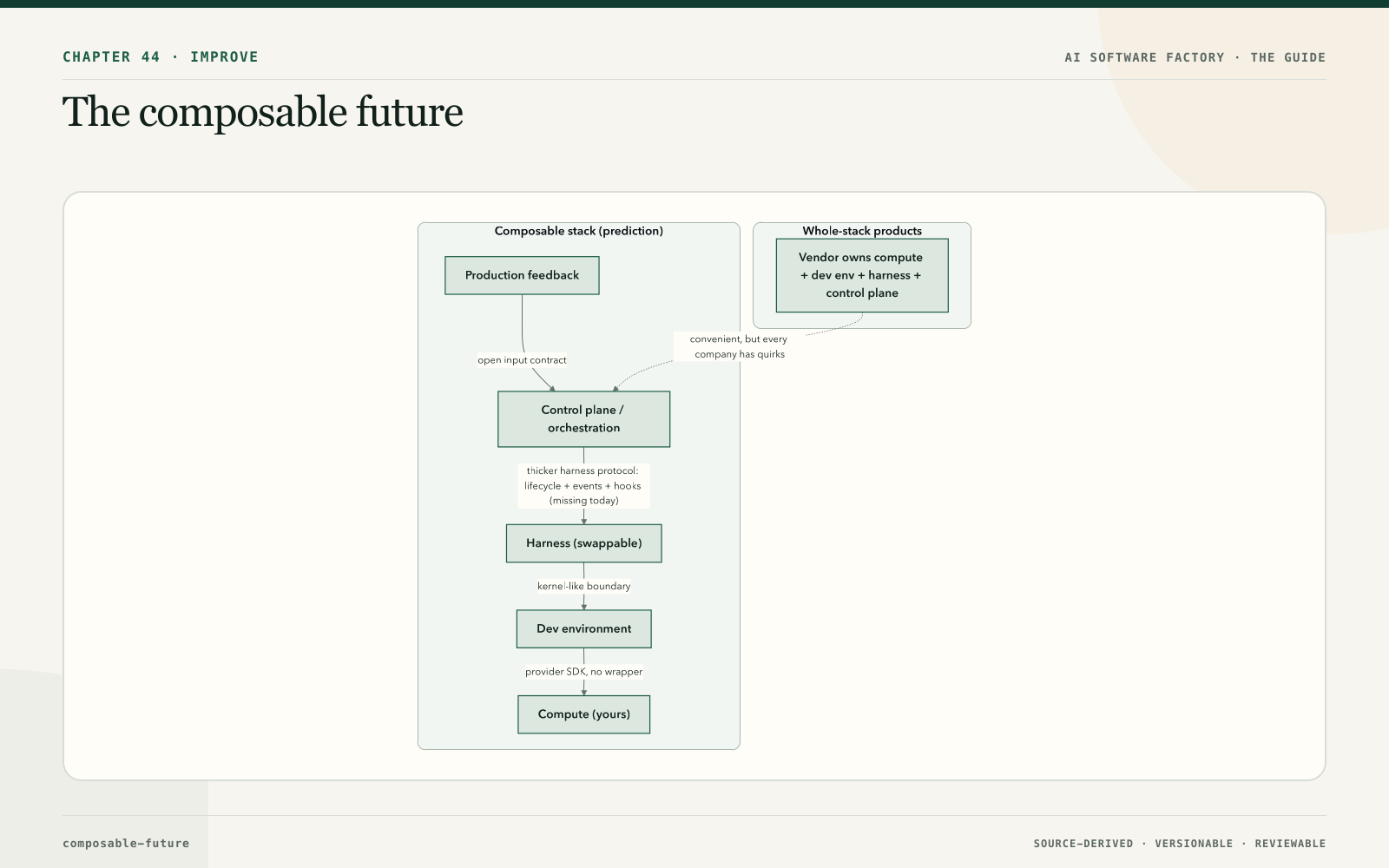
Between the control plane and the harness, the Agent Client Protocol exists, but it is narrow: an editor-to-agent transport with capability negotiation. AG-UI broadcasts events and UI state. Neither supports hooks — the mechanism a control plane needs to lifecycle a harness and react to its events with policy checks, evidence capture, or intervention — and the harnesses themselves disagree about what a hook is. One harness ships hooks as shell-level interceptors, another as a plugin system where hooks are a different concept altogether, a third has no equivalent. There is no standard because, so far, there rightly cannot be one: the harnesses embody different tradeoffs (one is "bring it and it is good", another is "configure every detail and get control"), and the abstraction that would represent all of them has not been discovered. The analogy the practitioners reach for is the web before React: dozens of frameworks, no shared concept, until someone noticed that state was the boundary and everything else devolved from it. Nobody has found the equivalent boundary for harnesses yet. That is a prediction about the shape of the answer, not the answer.
Between the harness and the development environment the boundary looks more like an operating-system kernel: what APIs does the environment expose, what control do you have, how do you set it up. Attempts at a universal compute SDK have tended to turn into benchmarks instead, and the practitioner view is that this layer does not need abstracting: once a company is large enough it is an AWS shop or a GCP shop, a Daytona user or not, and the provider's own SDK and CLI are already good. The older rule applies — do not wrap APIs with APIs. A thin client that passes most calls through and forces you to add a method for every new endpoint is worse than calling the official SDK at the call site.
Between production and the control plane sits the least-discussed seam: the input control plane that decides what counts as an issue. A team that receives untrusted feedback from other users' agents cannot hand it straight to an orchestration product; it has to run its own triage first (the pipeline in Chapter 39). This is the concrete reason the same team stopped using a single issue tracker as its source of truth: it needed two definitions of an issue and no product offered them.
Composition over inheritance
The prediction that follows from those seams is the one this chapter is named for. Today, whatever layer you buy at, you tend to inherit everything below it: buy orchestration and get the vendor's harness, sandbox, and compute whether you wanted them or not. The composable alternative is that each layer has an open interface and the engineer chooses per layer — buy the orchestration, bring your own harness, run on your own compute. It is composition over inheritance applied to the stack. Vendors are already moving: one orchestration product makes its harness swappable and declines to own compute because its serious customers prefer a good interface on top of infrastructure they own; one whole-stack vendor offers "outposts" that bring the harness and tooling into the customer's compute so the two co-own the environment; a model vendor sells its harness as a building block or as a full stack with scheduled automations. Enterprises, in this view, bring the compute and probably parts of the development environment and buy above that.
The most useful framing is that the product question at any one layer matters less than the open interfaces that let people mix and match. MCP is the existence proof: a narrow interface that created an ecosystem in which agent clients, harness builders, and integration builders could combine freely. Whether the next such interface arrives depends on whether the major harness vendors want to interoperate — and the early signs (rival configuration-file conventions, changing APIs) are that owning the harness is being treated the way owning the browser or owning mobile once was: a position worth fighting for because it pays. Call this the harness war, and expect it to slow standardization for a while.
Will there be a LAMP stack?
Asked whether a LAMP-stack equivalent will emerge for factories, the practitioners say yes, eventually, and not the way people expect. It will not be a particular web framework and database; it will be a conventional combination at the harness, development environment, and infrastructure layers, with the development environment playing the role Docker played.
Asked why there is no open-source control plane today, they give three reasons, all of which are worth keeping. First, it is now so easy to write code that nobody wants someone else's control plane unless it already has the integrations they need. Second, everyone building one wants to sell it, which is reasonable given how much design goes into it. Third, every company's working style has a different definition of an issue, a plan, and done, and a generic product cannot know them. The one open-source option people point to is itself another full stack that you bring compute to. The prediction is that an open control plane will come, but only after vendors have watched enough companies succeed and fail to know what the shared interface is — you could not build React the first time the web was invented — and that a vendor with a good production stack will be the one to open it. Where this guide's own thesis meets that prediction: the authoritative records and negative authority described in Chapter 5 are a candidate for the part that does not vary between companies, even when the definition of an issue does.
Extensible software and the agentic shell
The second large prediction is about what software itself becomes when agents can write code cheaply.
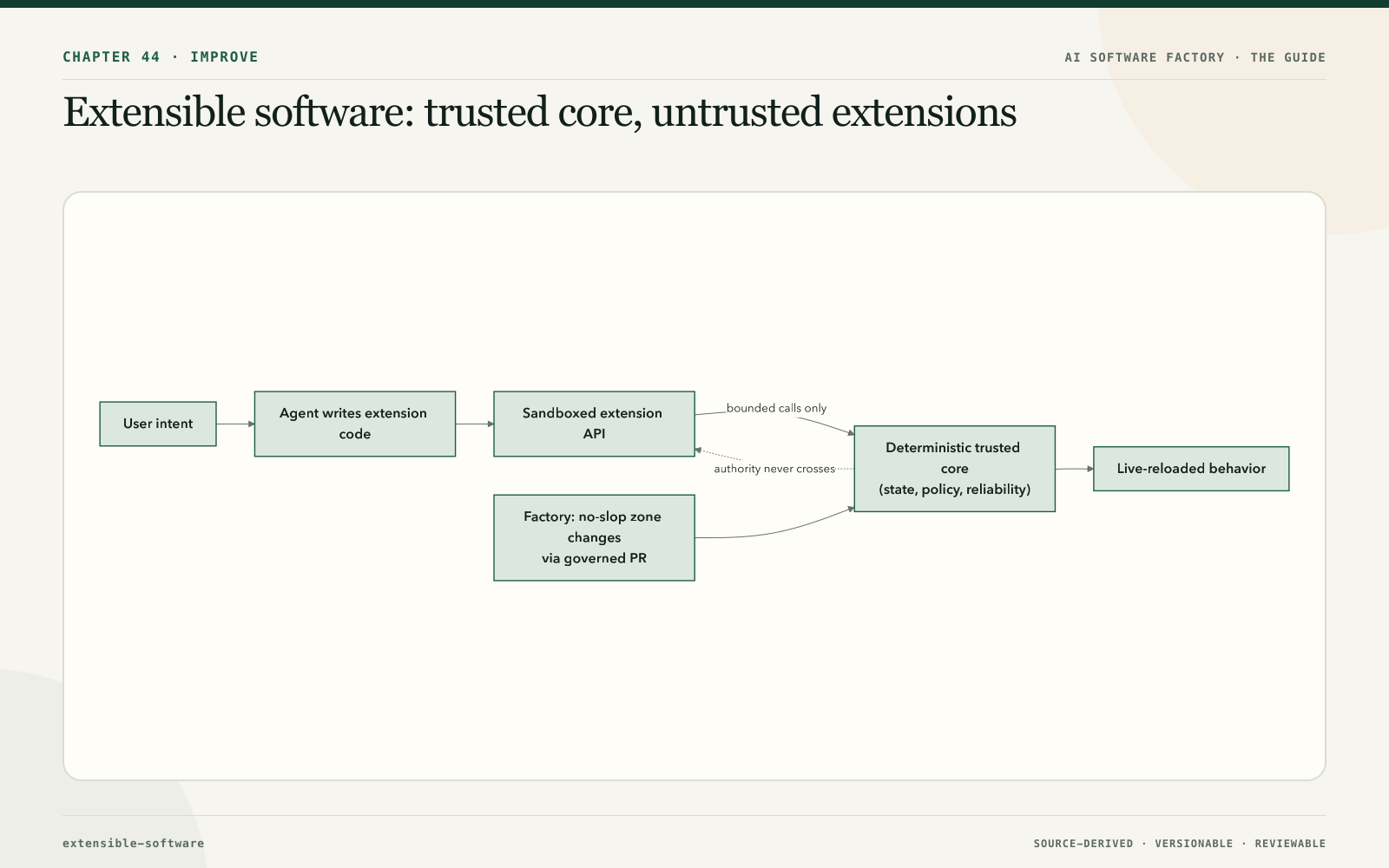
The idea is called code mode: the best way to extend software is to let an agent write code against it. Instead of a visual integration manager where you configure "when a webhook arrives, transform it this way, then run this workflow", you write the code that does it — or your agent does — and the application runs it. The observed versions are modest and already real: a coding harness whose customization is a plugin an agent can write and live-reload; an orchestration product configured by dropping TypeScript files into a directory; a product where users could, in principle, define their own columns and small workflows and add their own agent loops. Scheduled automations are the degenerate case — a cron job is "while true, at this time, run this code" — and the value people would pay for is the reliability underneath: if the server is down at that minute, it still runs a minute later somewhere else. Buy the reliability; write your own workflows.
The architecture that makes this safe is the trusted core with an untrusted extension boundary: a deterministic core that owns state, policy, and reliability, and a sandboxed extension API through which agent-written or user-written code can act, with bounded calls and no path for authority to cross back. Teams already describe their codebases this way — a functional core and a "no-slop zone" where changes go through the factory and a governed pull request, surrounded by zones where pragmatic, generated code is welcome. The phrase for the whole shape is an agentic shell around a deterministic core. What crosses the boundary is dynamic code generation: code written at run time, for this user and this moment, rather than shipped in a release, and the units it produces are agent-generated extensions, small versioned pieces of behavior that an agent authored and that the core loads through the sandboxed API with the same lifecycle (publish, activate, revoke) as any human-written plugin. Push it to its conclusion and the prediction is that every piece of software becomes a harness: an application that exposes a core and lets agents extend it in real time, the way editor extensions let a new tool work in the editor without the editor updating. The hard parts are unglamorous and unsolved: deciding what is core and what is code, which interfaces the code may call, and how to keep the sandbox honest. Nobody has a convincing demonstration yet; the demos that exist break during the livestream.
For a factory this matters in two directions. Outward, the factory is the mechanism that changes the no-slop zone — every extension boundary needs a governed path for changing the core. Inward, the factory itself is a piece of software with a deterministic core (the control plane and its records) and an obvious appetite for extensions (workflows, recipes, verifiers, learning signals), and the same boundary discipline applies: an extension may propose, never accept.
The adjacent patterns, ranked as adjacent
A coverage audit of the practitioner material sorted a set of patterns as lower priority than the production gaps — useful, adjacent, and not V1 requirements. They belong here rather than in the build chapters.
The first cluster is about prototypes as a way of learning before committing. Prototype-as-spec is a large generated prototype used as the specification itself, then sliced into reviewed PRs as in Chapter 39. An interaction mock is a clickable, generated approximation of a user interface built to test how something should feel before anyone decides how it should work. A discovery prototype is a throwaway built to answer one product question (will users understand this flow, does this data exist) and discarded once the answer is recorded. A tracer bullet, also called a technical spike, is a thin end-to-end slice through every layer of a proposed architecture, built to prove the path is passable rather than to deliver a feature, and kept only if it proves out. Beside them sit the prototype-to-production rewrite and visual regression evidence as a first-class artifact.
The second cluster is the extensibility material above: agent-generated extensions, code mode, dynamic code generation, the trusted-core boundary, the sandboxed extension API, and the agentic shell. The audit's ordering is the right posture: canonical stack boundaries, context engineering, evaluation, environments, feedback, multi-repository delivery, and the infrastructure landscape first; prototype and extensibility patterns last.
The research frontiers
Alongside the practitioner predictions sit the questions a research program should be tracking. The Software Factory Research Lab charter names ten topics: agentic software factories; autonomous software factories; dark software factories (the fully lights-out plant, no human in the loop, whose feasibility and desirability are both open); AI-native software development; agent orchestration for software engineering; coding-agent harnesses; specification-driven development (the spec as the executable source of truth, which Chapter 6 treats as intent engineering and which Mission Control's spec intake explores); autonomous testing and verification (whether independent verification can itself be generated and still be independent); human approval and governance models; and the current products, frameworks, research, benchmarks, and implementations.
The charter's discipline matters as much as its topics, because this field goes stale in months. Prefer sources published or materially updated within twelve months; allow up to twenty-four only for foundational work, flagged as such; reject undated content unless relevance is independently verified; record publication, update, and retrieval dates; never say "latest" without checking the date and searching for newer material; never rely on model memory for current products, benchmarks, or claims. For every important claim retain source, publisher, URL, dates, source type, supporting excerpt, confidence, freshness, corroborating and contradictory sources — and label it as verified fact, vendor claim, research finding, practitioner opinion, system inference, or unverified hypothesis. Most of this chapter is practitioner opinion and system inference; treat it accordingly.
The five-year shape
Jay's own roadmap is a plan, not a prediction, but it is the horizon this guide is written toward. Year one proves the model: MVP, one repeatable workflow, measurable results, design partners, a category narrative. Year two proves repeatability: more workflows, multiple repositories and teams, improved governance, established ROI, a small expert team, early revenue or a major internal mandate. Year three proves enterprise scale: multiple business units, enterprise system integration, strong security and compliance, organization-level productivity evidence, public recognition for the operating model. Year four leads the category: expansion beyond development into operations, incidents, security, and platform work; an ecosystem of agents, models, tools, and workflow templates; partnerships; the definitive playbook. Year five is the operating standard: Mission Control as an enterprise control plane, and human-agent software factories as a recognized field. Read against Chapter 43, year one is the twelve-month plan.
Open questions
The research canon lists what to study; it does not claim answers. The questions this guide leaves open, in rough order of how much depends on them:
- What is the boundary abstraction for harnesses — the "state" of the harness world — that would let a control plane lifecycle any harness through one protocol with hooks?
- Can independent verification be generated by agents and remain independent, or does autonomy in testing collapse the separation the whole factory rests on?
- Which records are invariant across companies (this guide's wager: the authoritative hierarchy and negative authority) and which are local definitions (issue, plan, done) that no shared control plane can own?
- Is a dark factory ever desirable for consequential software, or does the accountability model in Chapter 4 make "no human" a category error rather than a maturity level?
- What is the safe extension boundary — which calls may untrusted, agent-written code make into a trusted core, and how is that sandbox itself verified?
- Do outcome-normalized routing evidence and trust scores ever justify automatic autonomy promotion, and at what sample size?
- Will the harness war end in an open interface, and who opens it?
Architecture hypotheses and falsifiers
A future architecture should be maintained as a set of hypotheses, not turned into requirements by repetition. For every consequential bet, predeclare the signal that would weaken it and the design response. That makes the roadmap adaptable without making it arbitrary.
| Architecture hypothesis | Evidence that would weaken it | Design response |
|---|---|---|
| General model capability will increasingly commoditize. | Task-class evaluations show a persistent, strategically important advantage from one model family. | Support a model-optimized path while preserving the common lifecycle and evidence contract. |
| The harness remains a durable control boundary, although its intelligence may narrow. | Models reliably internalize planning, tool selection, and context management across production-like evaluations. | Remove duplicated harness intelligence; keep identity, authorization, policy, budgets, durable state, audit, recovery, and human authority outside the model. |
| Cost-aware routing remains economically material. | Inference cost becomes negligible relative to human attention, CI, latency, and failure cost. | Stop micro-optimizing price; continue routing for quality, security, data policy, latency, and availability. |
| Automated verification can absorb bounded classes of routine review. | It fails to beat a calibrated human baseline or produces critical misses. | Keep routine human review and restrict automation to advisory or lower-risk lanes. |
| Intent interfaces broaden safe participation in software creation. | Non-engineer lanes produce persistently high rework, ambiguity, or policy-failure rates. | Narrow eligible corridors and improve intent translation and context before granting broader autonomy. |
| Outcome-driven learning produces compounding improvement. | Attribution remains weak, or proposed changes fail controlled evaluations and canaries. | Keep learning advisory and improve telemetry and evaluations before permitting adaptation. |
Build for a moving boundary. Give each hypothesis an owner, measurement window, reevaluation date, and rollback path. A prediction that cannot state what would change the design is a slogan, not an architecture decision.
How to build it
You cannot build the future, but you can avoid building against it.
- Choose per layer, and know why. For compute, development environment, harness, control plane, and feedback, write down whether you buy, build, or bring, and the interface you expect to hold at each seam.
- Keep the harness swappable. A provider-neutral lifecycle contract (prepare, execute, cancel, collect, cleanup) and an exact capability manifest are the parts of this future you can build today.
- Do not wrap provider SDKs. Call them at the call site; abstract only where you have two real implementations.
- Own your input control plane. Define what an issue is for you and keep untrusted feedback outside the orchestration boundary until it earns standing.
- Draw the no-slop zone. Name the deterministic core, the governed path for changing it, and the zones where generated code is acceptable.
- If you expose an extension API, write the boundary contract first: which calls exist, what authority each may never acquire, how extensions are sandboxed, versioned, live-reloaded, and revoked, and how the core verifies the sandbox.
- Run the research discipline. Date every source, classify every claim, and re-review framework and protocol links at least quarterly.
- Label your own roadmap. Built, claimed, predicted. Keep the three words in every planning document.
Failure modes
Inheriting the stack. Buying at one layer and discovering you own the vendor's compute, sandbox, and definitions of done. Detect it when a change at one layer requires renegotiating the others; prevent it by choosing per layer with named interfaces.
Wrapping the world. A house abstraction over every provider that adds a method per endpoint and drifts behind the official SDK. Detect it by counting pass-through methods; fix it by deleting the wrapper.
Predictions as requirements. Extensible software, dark factories, and open control planes appearing in a V1 backlog. Detect it when a roadmap item has no evidence state; fix it with the built-claimed-predicted label.
An extension boundary that leaks. Agent-written code that can reach policy, credentials, or acceptance. Detect it by enumerating what the extension API can call and reconciling against the negative-authority table; fix it before the first extension ships, not after.
Stale research. A brief that cites a benchmark or product capability from eighteen months ago as current. Detect it by the retrieval dates; fix it by the freshness policy.
Waiting for the standard. Refusing to build until the harness protocol settles. The composable stack is a prediction; the swappable harness contract is available now.
In Mission Control
At d902fae
and b3dfcee, Mission Control has already made the composable choices this
chapter recommends: a provider-neutral Generic Harness Contract with exact
capability manifests and a swappable adapter registry (codex/v1 admitted,
DeepSeek experimental, a pluggable engine adapter); a SandboxProvider abstraction with
local and remote backends; six versioned YAML workflows and a recipe catalog
that resolve to canonical workflows rather than a second engine; a skills
registry with SKILL.md parsing and linting; and a control plane that treats
Factory Memory, evals, and learning as advisory projections — a deterministic
core with advisory shells. The Research Lab workspace and operator-triggered
research path exist with atomic artifact, observation, cursor, and
verification-receipt lineage, and scheduled research still fails closed while
continuousSchedulingEnabled is false.
None of the predictions here is implemented. There is no code-mode extension API, no sandboxed user- or agent-written extension boundary, no live-reloaded extensions, no open harness lifecycle protocol beyond Mission Control's own contract, no governed MCP gateway, no dark-factory mode, and exact skill binding into the execution manifest was not observed. Those are future by the repository's own labels, and this chapter does not promote them.
Retain this
- The layers are agreed; the seams are not. The missing interface is a thicker harness protocol with lifecycle, events, and hooks, and nobody has found its "state" abstraction yet.
- Composition over inheritance: choose per layer, keep the harness swappable, bring your own compute, do not wrap provider SDKs.
- A LAMP-stack equivalent and an open control plane are predicted, later than people hope, after enough companies have shown what is shared. The harness war will slow it.
- Extensible software means an agentic shell around a deterministic core with a sandboxed extension boundary; every piece of software may become a harness. Adjacent, not V1.
- Research frontiers: dark factories, spec-driven development, autonomous testing and verification, governance models — tracked with dated sources and labeled claims.
- Five years: prove the model, prove repeatability, prove enterprise scale, lead the category, become the operating standard.
- Treat predictions as falsifiable architecture bets: name the evidence that would weaken each bet, the response, owner, review date, and rollback path. Built, claimed, and predicted still remain distinct.
Go deeper
- Chapter 2 — The factory in one view and Chapter 17 — Development environments, sandboxes, and compute for the stack and build-versus-buy as they stand today.
- Chapter 15 — Coding harnesses and agent protocols for ACP, AG-UI, hooks, and the harness contract.
- Chapter 6 — Intent and specification engineering for the spec-driven thread.
- Chapter 38 — Enterprise adoption and the infrastructure landscape for the vendor landscape.
- Chapter 39 — Production feedback, review, and the agentic merge queue for prototype-as-spec and the input control plane.
- Chapter 42 — Mission Control as a living case study and Chapter 43 — Mastering the factory.
- Appendix C — Research canon — the sources to study, and the maintenance rule that links are reviewed quarterly and specification versions pinned.
- Glossary.
- Sources: HumanLayer (Dexter) and BAML (Vaibhav), "Software factory design patterns" livestream — where the pattern is evolving, why interfaces matter, the LAMP-stack question, the harness war, and extensible software; "The 12-layer production AI agent stack" coverage audit — the lower-priority material list and recommended documentation sequence; Jay West, "Software Factory Research Lab" PRD and mission — research topics, freshness and source-quality policy, claim classification; Jay West, "AI Software Factory Mission" — the five-year roadmap; Jay West, Beyond Coding Agents: The Architecture of the Autonomous Software Factory — the opening thesis and falsifiable architecture bets (primary-author working paper, reviewed 2026-09-03).
- Primary references for the interfaces named here: Agent Client Protocol; AG-UI documentation; Model Context Protocol specification 2026-07-28; Claude Code hooks reference (all listed in Appendix C).