Mission Control operator surfaces
On this page13 sections
Mission Control presents one governed lifecycle through eleven job-specific surfaces. Each surface makes a particular decision or record easier to inspect, but presentation never creates authority: the underlying policy, evidence, and lifecycle records remain canonical.
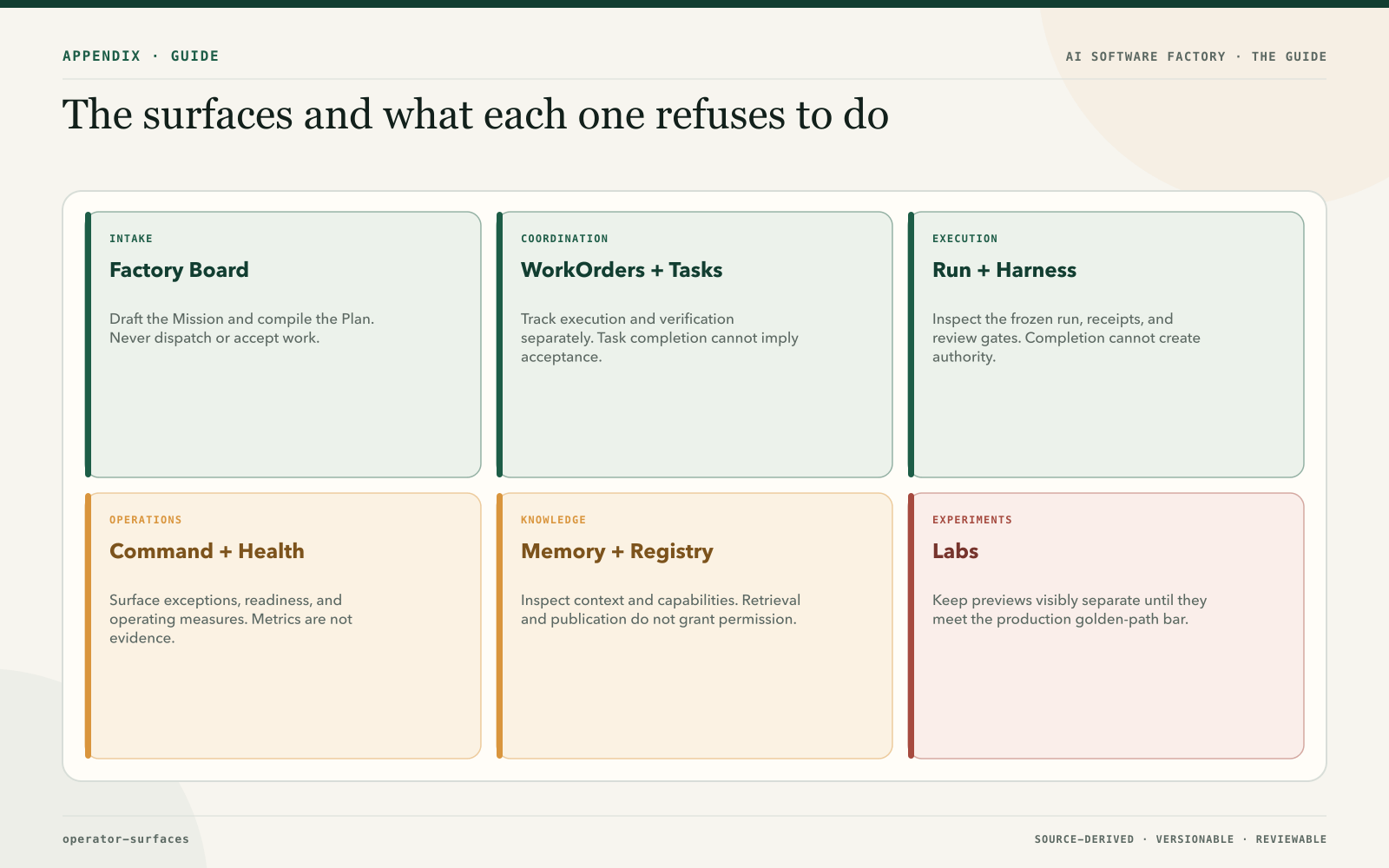
Command Center
Job. Exception-first triage of decisions, blockers, failed or stale evidence, and aging work
Boundary. Must not show routine activity as news.
Factory Board
Job. Guided entry: recipe recommendation, Mission draft with a stop condition, Plan compile
Boundary. Must not dispatch or accept work.
Work Orders queue
Job. Govern, dispatch, verify, and accept WorkOrders, showing Tasks Done and blocking criteria verified as two counts
Boundary. Must not enable acceptance before independent verification and a human decision.
Tasks board
Job. Inbox, Ready, In Progress, Review, Needs Approval, Blocked, Done
Boundary. Must not let a Task's Done state accept its WorkOrder.
Execution Run Inspector
Job. The frozen executor snapshot, the engine phase, the required action, the frozen Factory context, and the exact receipts for one Attempt
Boundary. Must not label engine completion as acceptance.
Factory Overview
Job. KPI strip, dispatch gate state, and the architecture diagram
Boundary. Must not hide a failed readiness check.
Factory Health
Job. Human touches per agent task, shared component contributions, workflow versus interactive token spend
Boundary. Must not report a metric as evidence.
Knowledge → Memory
Job. Overview, Memory, Graph, and Context views over Factory Memory and Context Packages
Boundary. Must not let retrieved text approve, invoke, or satisfy anything.
Registry
Job. Discover, Skill Inventory, Installations, CDL, Evaluate Skill, Eval Runs
Boundary. Must not treat publication as permission to run.
Harness engineering
Job. Change review, merge gates, mutation testing, the seven-step code-review wizard, the Agent Fleet view
Boundary. Must not let a gate merge or a fleet view grant authority.
Labs
Job. Experimental surfaces in preview until they meet the golden-path bar
Boundary. Must not present a preview as a production feature.
How the surfaces fit together
The Engineering OS groups these surfaces under Strategy, Delivery, Operations, Intelligence, Knowledge, and Governance. They call the same authorized functions and read the same records as the CLI. A surface may propose, inspect, or request a decision; it may not silently dispatch, verify, accept, merge, or promote work.
Go deeper
- 42. Mission Control as a living case study for the complete architecture and evidence boundary.
- 34. The factory as a platform for the Engineering OS shell.
- Canonical glossary for the records and authority terms used here.